

Compensation Planning in 6 Steps: 2026 Employer Guide
 By
By
Budget $60,000 for a new hire and you'll actually spend closer to $85,000 once benefits and payroll taxes land. That gap is where most pay decisions quietly fall apart, long before the numbers reach real pay stubs. Compensation planning is how you close it. You decide what each role is worth and what you can afford. Then you defend both numbers when an employee asks. This guide covers the six steps and the four models behind them. It also covers the pay transparency rules now in force in more than a dozen states, plus what happens once the plan reaches payroll. The process scales from a first hire to an annual cycle for 200 people.
Key Takeaways
- Compensation planning sets what you pay each role, backed by a philosophy, market data, salary ranges, and a budget.
- Benefits add roughly 30% on top of wages, so a salary figure is never the real cost of a hire.
- The six steps: philosophy, benchmarking, job analysis, pay structure, budget, and communication.
- More than a dozen states now require a salary range in job postings, which makes sloppy ranges a hiring liability.
- A plan only becomes real once payroll executes it and the pay stub reflects it.
- What Is Compensation Planning?
- Why Compensation Planning Matters in 2026
- What Are the Four Types of Compensation?
- Creating a Compensation Plan in 6 Steps
- Which Compensation Model Should You Use?
- Pay Transparency and Legal Requirements
- From Compensation Plan to Paycheck
- What Breaks a Compensation Plan in Year Two
- Conclusion: Putting Compensation Planning Into Practice
What Is Compensation Planning?
Compensation planning is the process of deciding what you pay every role, and why. It covers four things: your pay philosophy, market benchmarking, salary ranges, and the budget behind them. Most companies run a full cycle once a year, then adjust off-cycle when they hire or the market moves.
That "and why" matters. A pay number without reasoning behind it can't survive a hard question from a good employee. It also can't be applied consistently when a manager wants an exception.
Two terms get used interchangeably and shouldn't be. The design work is philosophy, benchmarking, and ranges. Compensation management is running that design afterward, including merit cycles and increase approvals. In a small business, the same person does both.
Ownership varies by size. In larger organizations HR designs, finance funds, and executives approve. If you run a twelve-person company, all three hats are yours. That's faster, as long as you write the decisions down.
Why Compensation Planning Matters in 2026

Pay isn't holding still. Compensation costs for private industry workers rose 3.4% in the year ending March 2026. A salary you benchmarked eighteen months ago now describes a market that no longer exists.
The cost of getting this wrong shows up twice. First in turnover, when someone leaves for a number you could have matched. Then in hiring, when the replacement costs more than the raise would have.
A documented compensation strategy also protects you from your own worst instincts. Without one, pay drifts toward whoever negotiates hardest, which is rarely whoever contributes most. Strategic compensation means the answer to "what should this role pay" exists before anyone walks in to ask.
What Are the Four Types of Compensation?
The four types are base pay, variable pay, benefits, and equity. Base pay is salary or hourly wages. Variable pay covers bonuses, commission, and incentive pay. Benefits include health insurance, retirement, and paid time off. Equity means stock options. Base and variable pay are direct compensation; benefits and equity are indirect compensation.
Indirect compensation isn't a rounding error. According to the Bureau of Labor Statistics, benefits accounted for 30.1% of employer compensation costs in private industry as of March 2026. That's $14.01 per hour worked. Total compensation for civilian workers averaged $49.32 per hour. Against a $60,000 salary, the real commitment lands near $85,000.
Base salary anchors everything and is what candidates compare first. Variable pay flexes with performance, protecting cash flow in a slow quarter. Benefits are the least visible piece and the most undervalued. That's why a total rewards summary is worth sending once a year. Equity matters mostly to startups; a total compensation package without it still wins if the base is honest.
Creating a Compensation Plan in 6 Steps

The work goes fastest as a sequence, because each step depends on the one before it. To keep it concrete, we'll carry one role through all six: a customer support specialist at a twelve-person company.
Step 1: Define Your Compensation Philosophy
Your compensation philosophy is a short written statement of where you intend to pay relative to the market. Most companies pick a percentile: at market (50th), above market (60th to 75th), or below market. If you go below, something else closes the gap, like flexibility or equity.
Write it in three sentences. If you can't state your position that briefly, every pay decision after this gets improvised. This is also where you pick a compensation model, covered next.
Step 2: Benchmark Against Market Data
Now find out what the role actually pays. Start with the Bureau of Labor Statistics Occupational Employment and Wage Statistics, which costs nothing to use. It gives you wage data by occupation and metro area. Commercial sources like Payscale, Salary.com, Glassdoor, and LinkedIn Salary fill in titles the government data doesn't split out.
Each source has a bias. Government data is reliable but lags about a year. Self-reported market data skews high, because people who volunteer their salary usually have a good one. Pull two or three and use the overlap.
For our support specialist, market research puts the midpoint at $52,000.
Step 3: Run a Job Analysis and Check Internal Equity
A job analysis documents what the role does now, not what the job description said three years ago. List the real responsibilities, the skills required, and the level of independence.
Then check internal equity by lining up everyone doing comparable work. If two people carry the same responsibilities at meaningfully different pay, you need a defensible reason. "They negotiated better" isn't one, and it's the kind of gap that becomes a legal problem once ranges go public.
Step 4: Build Your Pay Structure and Salary Ranges
Group similar roles into grades, then give each grade a minimum, midpoint, and maximum. A common spread is the midpoint plus or minus 15%.
For the support specialist at a $52,000 salary midpoint, that produces salary ranges of $44,200 to $59,800. Our current employee earns $46,800, a compa-ratio of 0.90. That's normal for someone still developing and low if she's fully proficient.
Keep the number of salary bands small. Most companies under 100 people need four to six, not twenty.
Step 5: Set the Compensation Budget
Your compensation budget turns a pay structure into something you can fund. Total your current base payroll, then decide what percentage you can commit to increases.
With twelve employees at $720,000 in total base pay, a 3% merit pool is $21,600. Add the employer's 7.65% payroll tax on that increase and the true cost is $23,252. Budget the tax with the raise, not after it.
Moving our specialist from $46,800 to $50,000 costs $3,200 plus $245 in employer payroll tax.
Step 6: Communicate and Document the Plan
Tell people the range for their role, where they sit in it, and what moves them. A merit increase with no explanation reads as random, which wastes the money you just spent.
Then hand off to payroll, because an approved raise that never reaches the paycheck is the same as no raise.
Which Compensation Model Should You Use?
Most companies pick one of four compensation models: market-based (pay the going rate), performance-based (pay for results), skill-based (pay for capability), or a blend. Market-based is the safest default for small businesses because it is the easiest to defend and benchmark. Performance-based works best where output is measurable.
| Compensation model | How it sets pay | Best for |
|---|---|---|
| Market-based | Benchmarks against what competitors pay | Most small and mid-sized employers |
| Performance-based | Ties a real share of pay to measurable results | Sales and roles with clean metrics |
| Skill-based | Pays for certifications and demonstrated capability | Trades, technical teams, clinical roles |
| Blended | Market ranges, performance-driven position in range | Structure without rigidity |
Most employers end up blended without naming it, which is fine if it's deliberate. Trouble starts when the model is market-based on paper but performance-based in practice, because the ranges stop predicting what anyone earns.
What Compensation Modeling Tells You Before You Commit
Test the cost of a decision before approving it. Take current payroll, apply the increase you're considering, and add employer payroll tax. A 3% pool and a 4% pool look similar in a meeting and differ by thousands over a year. Model both, then choose.
Pay Transparency and Legal Requirements
Pay ranges aren't private anymore. More than a dozen states plus Washington, D.C. now require employers to disclose a salary range, with Virginia's requirement taking effect July 1, 2026. Some states want the range in every posting, others only on request.
This changes how you build ranges. A band spanning three job levels was survivable when nobody saw it. Published, it tells candidates you don't know what the role is worth.
Pay equity obligations run alongside. Documented ranges and a written job analysis are your evidence that pay differences track responsibilities. Classification under the Fair Labor Standards Act also constrains the plan, since exempt and non-exempt roles carry different overtime obligations.
From Compensation Plan to Paycheck
A compensation plan isn't finished when it's approved. It's finished when it shows up correctly on someone's pay stub.
The handoff is where plans break. An approved salary becomes a payroll record. That record has to reflect the exact base rate, bonus structure, and effective date you agreed to. Our specialist's raise should appear on the first full pay period after the effective date, not the one after that.
Remember the employer side too. You pay 7.65% in FICA on every wage dollar, split between Social Security and Medicare. That's real money that never appears in the salary conversation but always appears in the budget.
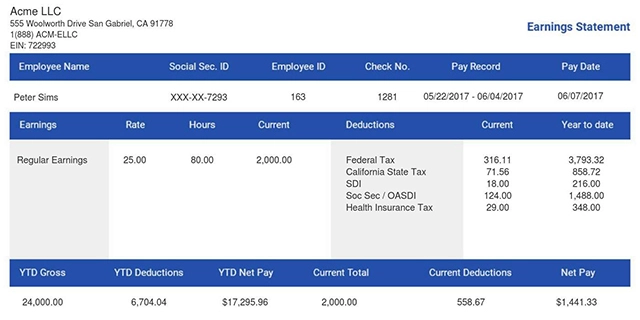
The pay stub is the employee's proof the plan was honored. Base, overtime, bonus, and deductions should each trace back to something the plan promised. Need clean pay documentation for your team? Our pay stub templates handle the formatting.
What Breaks a Compensation Plan in Year Two
Compensation planning rarely fails at launch. It fails quietly, about eighteen months in, usually one of three ways.
Salary compression. The market rises, internal pay doesn't, and new hires arrive priced above tenured staff doing the same work. Re-benchmark annually and budget for adjustments, not just merit.
The unbudgeted counteroffer. Someone resigns, you panic, and approve a number outside the range. The band is now fiction for everyone else in it. Decide your counteroffer policy before you need one.
Undocumented exceptions. One-off approvals that never get written down accumulate until the structure stops describing reality. Log each exception with its reason and review annually.
Your Compensation Planning Calendar
Benchmark in Q3, set the budget with your fiscal plan in Q4, communicate and execute in Q1, spot-check at mid-year. Off-cycle trigger: re-price any role you're hiring for if you last benchmarked it over twelve months ago.
You Might Also Like
- What Is Compensation in Human Resources?
- Different Types of Compensation
- Payroll Processing: How It Works
- Pay Period Breakdown
- How to Read Pay Stub Deduction Codes
Conclusion: Putting Compensation Planning Into Practice
None of this is complicated, it just has to be written down. You need a philosophy in three sentences and benchmarks from two or three sources. You also need ranges with a real midpoint, a budget that includes payroll tax, and a calendar that forces an annual look. That works the same at twelve employees as at two hundred.
Start with one role. Benchmark it, build a range around it, and check where your current people sit. The pattern you find usually tells you what the rest needs to fix.
Once the numbers are set, your team needs accurate pay records to match. Create professional pay documentation in minutes with our paystub generator.
- 1. Enter Your Information

- 2. Select Your Favorite Theme

- 3. Download Your Stub!


 By
By