

Proof of Income to Visit Brazil: What US Travelers Actually Need in 2026
 By
By
If you have been told you need $2,000 in the bank before Brazil will let you in, you have heard half a story. Proof of income to visit Brazil is real. But it does not apply to every traveler, and it does not apply to the route most Americans use. It depends on whether you apply online or in person, a distinction this ThePayStubs.com guide untangles.
This article separates them. Below you will find what the official e-Visa portal actually asks for. You will see where the $2,000 minimum comes from, and how the consulate words it. You will also find which documents count as proof of funds, what to do if your balance falls short, and how self-employed and gig workers handle it. We finish with costs, and with what Brazil's Federal Police can ask you for after you land. Every figure here comes from the Brazilian government's own pages, and every source is linked so you can check it yourself before you book.
Key Takeaways
- Brazil reinstated visas for all US nationals on April 10, 2025, and the requirement is still in force in 2026.
- The online e-Visa lists only two mandatory documents for adults: a photo and your passport bio page. No bank statement is requested.
- The $2,000 minimum belongs to the in-person consular visitor visa at the Miami consulate, not to the e-Visa.
- On the consular route you show either your last three bank statements or your last six pay stubs.
- If you fall short of the minimum, a sponsor can sign a notarized Affidavit of Support on your behalf.
- The government fee is US$80.90 for the e-Visa, and US$185.00 for a consular visitor visa at Miami.
- Do Americans Need a Visa for Brazil in 2026?
- Proof of Income to Visit Brazil Depends on Which Visa You Apply For
- Brazil E-Visa Requirements: The Only Two Documents Adults Upload
- The Consular Visitor Visa and the $2,000 Rule
- What Counts as Proof of Funds for Brazil
- What to Do If You Do Not Meet the $2,000 Minimum
- Proof of Income to Visit Brazil When You Are Self-Employed
- How Long the Brazil E-Visa Lasts and How Long You Can Stay
- Brazil Visa Cost in 2026 and the Third-Party Fee Trap
- How to Apply for a Brazil Visa From the USA
- How Long Does It Take to Get a Brazil Visa?
- How to Check Your Brazil Visa Status
- What the Federal Police Can Ask For When You Land in Brazil
- Brazil Visa Requirements for US Citizens 2026: What Changed
- Why Brazil Reinstated Visas for Americans
Do Americans Need a Visa for Brazil in 2026?
Yes. Brazil reinstated its visa requirement for all US nationals on April 10, 2025, and it remains in force. Most tourists use the electronic visitor visa, applied for online at brazil.vfsevisa.com for a US$80.90 government fee. Canadian and Australian citizens are covered by the same rule and the same e-Visa portal.
The Brazil visa for US citizens is therefore back after a six-year pause. The change ended a visa-free window that had been open to Americans since 2019. The US Embassy in Brazil told citizens in April 2025 that the Government of Brazil would "reinstate a visa requirement for all U.S. nationals visiting Brazil, with an option for an e-visa for qualified applicants," and pointed travelers to the Brazilian government-official portal.
One point causes constant confusion, so it is worth stating plainly: a visa is permission to travel to Brazil and request entry. It is not a guarantee of entry, and it is not the same thing as the financial checks that can happen at the border. Those are two separate stages with two different sets of expectations, and we cover both below.
Proof of Income to Visit Brazil Depends on Which Visa You Apply For

Here is the distinction that almost every article gets wrong. The Brazil visitor visa comes in two forms, and they carry completely different document lists. Brazil visa requirements for US citizens depend on which of the two you choose. That is why proof of income to visit Brazil is required for some travelers and beside the point for others.
| Electronic Visitor Visa (e-Visa) | Consular Visitor Visa (VIVIS) | |
|---|---|---|
| Where you apply | Online at brazil.vfsevisa.com | In person, through your Brazilian consulate |
| Who can use it | US, Canadian and Australian passport holders | All nationalities |
| Proof of income required | Not listed as a mandatory document | Yes; the Miami consulate applies a US$2,000.00 average |
| Mandatory adult documents | Recent photograph, color copy of passport bio page | Full checklist including letter of intent and proof of residence |
| Government fee | US$80.90 | US$185.00 for US passports at Miami |
| Processing time | Up to 10 business days | Varies by consulate demand |
| Purpose covered | Tourism and business | Tourism and business |
The Consulate-General of Brazil in Miami says so on its own visitor visa page. Citizens of Australia, Canada and the United States can take the Electronic Visitor Visa route instead. It comes, in the consulate's words, "with simplified requirements (only passport and photo) and a lower fee."
So if you are a US tourist applying online, proof of income to visit Brazil is not on your upload list. That covers most travelers. If you are applying in person at a consulate, it very much is. Read the section that matches your route and ignore the other one.
Put simply, Brazil tourist visa requirements are not one list. They are two, and the internet keeps merging them into a single set of rules that matches neither.
Brazil E-Visa Requirements: The Only Two Documents Adults Upload
The official Brazil e-Visa portal is operated by VFS Global on behalf of the Brazilian government. Its tourist visa page lists exactly two mandatory documents for an adult applicant:
- A recent photograph of the applicant, matching the portal's published photo specification.
- A color copy of your passport bio page.
That is the whole mandatory list for adults. There is no field asking for a bank statement, no request for pay stubs, and no stated minimum balance. The Brazilian foreign ministry's own e-Visa page agrees. It lists a valid signed passport with two free visa pages, the online form, a 2 inch by 2 inch white-background photo, and the US$80.90 fee.
Two caveats matter. First, the portal notes that "consular offices may request additional documents at their discretion." So a bank statement can still be asked for in one-off cases, even though it is not a standard rule. Second, minors have a longer list, including a birth certificate, a notarized authorization letter signed by both parents, and copies of both parents' passport bio pages. Children of a Brazilian parent also need a signed statement of non-citizenship.
Passport validity is the requirement travelers most often get wrong, usually because they apply the familiar six-month rule of thumb. For a US passport that is not what Brazil asks. The US State Department's Brazil page states your passport "must be valid for one month at the time of entry," and the e-Visa portal says the same. The six-month rule applies to passports from other countries, not to Americans. You do need blank pages, though. The form asks for two free visa pages. Leave at least one blank page per stamp, since Brazil stamps both entry and exit.
The portal and the consulate use the same photo standard. It must be a recent, good-quality 2 inch by 2 inch color photo, on a white or light background, following ICAO passport-photo guidelines. Brazil visa photo requirements are a common reason an application gets sent back. Use a pharmacy or a passport-photo service. A phone snapshot against a bedroom wall will not do.
The Consular Visitor Visa and the $2,000 Rule

Apply in person rather than online and proof of income becomes a must. This is where the 2000 rule Brazil travelers keep hearing about actually lives. The Consulate-General of Brazil in Miami states the requirement in its visitor visa checklist:
Proof of income (Last 03 checking/ savings account statements or the last 06 Pay Stubs), with the minimum average of U$2,000.00 or more.
The consulate explains why on the same page. "Brazilian law requires that tourists prove that they are able to pay of maintaining themselves during their intended stay in Brazil," it says. Tourists must hold "financial means compatible with those of an international tourist."
One detail trips people up constantly. The consulate stresses it in its own text. You must show proof of income covering the last 90 days. The consulate spells that out as "all last 3 months", not "1 of the last 3 months". Sending a single strong month and hoping it carries the average is one of the easiest ways to have an application bounced back.
The figure is a minimum average, not a hard floor you must hold on any single day. The consulate wants three statements averaging well above US$2,000. A balance that dips mid-month between paychecks is normal, and expected.
One more thing worth knowing, because no other guide says it: the $2,000 figure is specific to the Miami consulate. It is not a national rule in Brazilian law. The consulates in Washington DC and Los Angeles ask for "proof of financial capability during the stay in Brazil." Neither names a dollar amount. Chicago asks for three months of statements, with no threshold. Washington DC does not even process consular visitor visas for Americans, listing the e-Visa as the route for US, Canadian and Australian passports. Brazilian law itself is vague on purpose. It asks only for "proof of means of subsistence compatible with the duration and purpose of the intended trip."
So treat US$2,000 as a well-documented benchmark, not a magic number. It tells you what a Brazilian consular officer considers adequate. Check the page for the consulate that covers your own state before you gather anything.
What Counts as Proof of Funds for Brazil
Brazil proof of funds rules are more flexible than the headline number suggests. The consulate gives three accepted options, and you choose one rather than supplying all of them. The proof of funds Brazil accepts is paperwork, not a deposit or a bond, so nothing is frozen and nothing is paid. If you have gathered employment verification and proof of income documents for a landlord or a lender before, the paperwork will feel familiar.
Option 1: Your last three checking or savings account statements. These must be from US banks only. Each statement must show your name. It must also show the opening and closing balance, plus total credits and debits. The consulate says the first summary page of each monthly statement usually has all it needs. You do not have to print forty pages of transactions. You are also allowed to cover your account number with correcting tape.
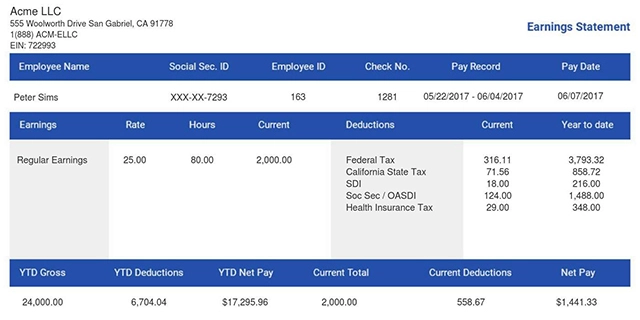
Option 2: Your last six pay stubs. Each stub must show your name and the company you work for. It must also show what you earn, and how often you are paid. This option exists for people whose balance swings but whose income is steady. That describes a great many working Americans. If you are missing copies, your employer's payroll or HR contact can usually reissue them. Pay stubs carry the same weight here as they do when lenders ask for pay stubs on a loan application. They show a name, an employer, an amount and a rhythm.
Option 3: Business bank statements, if you own the business. You must also prove you own it. The Miami consulate gives an example. Print your company's record from the state business registry, showing your name as owner. Send it with the company's last three bank statements. You then sign an Affidavit of Support from your company to yourself.
For small business owners this third route matters more than it first appears. Say you pay yourself in fits and starts, and your personal account looks thin. Your company's statements, plus proof of ownership, can carry the whole file. If you run payroll for employees, expect requests too. An employee applying for a consular visitor visa will ask you for six months of pay stubs. Clean, consistent payroll records turn that into a two-minute favor rather than a scramble.
What to Do If You Do Not Meet the $2,000 Minimum
Falling short is not the end of the application. The consulate builds in a sponsor route, and it is a normal, documented path rather than a workaround.
If proof of income to visit Brazil is the one requirement you cannot meet, you present an Affidavit of Support. The consulate publishes the form. A sponsor signs it, and takes on the cost of your stay. Alongside it you submit:
- A copy of your sponsor's photo ID, showing both photo and signature. The original works if they attend the interview with you; otherwise a notarized copy is required.
- Your sponsor's own proof of income, following the same rules that applied to you: their last three bank statements or their last six pay stubs. If they are employed, an employment verification letter from their employer strengthens the file.
- A notarized signature on the affidavit itself, if your sponsor cannot attend the visa interview in person.
One restriction catches people out. Your sponsor cannot be someone living in Brazil. A Brazilian friend, partner or relative there can send you a letter of invitation. That is a different document, and an optional one. They cannot serve as your financial sponsor.
The same affidavit process covers minors, where a parent or legal guardian submits their own proof of income along with the signed affidavit. Our wider guide on how the self-employed show proof of income covers the same problem outside the visa context.
Proof of Income to Visit Brazil When You Are Self-Employed
The consular checklist assumes a traditional job. Roughly one in six American workers does not have one, and this is the group that finds proof of income to visit Brazil hardest to assemble. Here is how the three options map onto irregular income.
If you are a freelancer or 1099 contractor, the fact that independent contractors rarely receive a traditional pay stub is exactly the problem. Proof of income to visit Brazil is usually easiest to show with bank statements, because they show money actually arriving. Three months of deposits from named clients reads as income even without a formal stub. Keep the summary pages. If a deposit looks unusually large or lumpy, explain it in your letter of intent. Do not leave the officer to guess.
If you are a gig worker driving, delivering, or working through platforms, proof of income to visit Brazil comes from two sides. Your earnings statements from each platform, plus the matching bank deposits, tell one story. The same approach works if you are paid in cash and need to prove income. The consulate's concern is stability and enough, not the format of the paperwork.
If you pay yourself from your own company, use Option 3 above. Business statements plus proof of ownership plus an affidavit from the company to you is the path the consulate explicitly describes.
If your income is genuinely seasonal, the three-month window can land badly. A contractor whose work peaks in summer will look very different in February. There the sponsor route is often faster than arguing the average. There is no penalty for using it.
Whatever your situation, consistency is what gets read. Documents that disagree cause far more trouble than a small balance does. A stated income that does not match visible deposits is the classic example. A modest but consistent record beats a large but unexplained one every time.
How Long the Brazil E-Visa Lasts and How Long You Can Stay
Two different clocks run here, and mixing them up is how people end up overstaying.
The visa's clock. For US citizens the Brazil e-Visa is issued for 10 years, with multiple entries. The Consulate-General of Brazil in Chicago confirms it. The fee is US$80.90 "and the visa will be valid for 10 years." Apply once and you are covered for a decade of trips. That changes the math on the US$80.90.
Your stay clock. Brazilian immigration law sets the visit stay at up to 90 days per entry. The Federal Police can extend that by up to ninety days. The law caps total stay at "one hundred and eighty days per migratory year." The e-Visa portal words this more tightly, as 90 days per year. One reading keeps you safe under both. Plan on 90 days. Ask the Federal Police inside Brazil if you need more. Never assume you can run past 180 days in a migratory year.
Brazil Visa Cost in 2026 and the Third-Party Fee Trap
There are two official price points. Then there is what many travelers actually end up paying. So how much is a visa to Brazil? It depends entirely on the route you take.
| Route | Official fee | How you pay |
|---|---|---|
| Electronic Visitor Visa (e-Visa) | US$80.90 | Online, credit or debit card |
| Consular Visitor Visa, US passport (Miami) | US$185.00 | US bank debit card, or USPS money order |
| Consular Visitor Visa, most other passports (Miami) | US$80.00 | US bank debit card, or USPS money order |
The e-Visa figure breaks down as US$80.00 to the Brazilian government plus a US$0.90 service fee charged by the portal operator. Both parts are non-refundable, including if your application is refused, so check your document specifications before you pay rather than after.
The Miami consulate takes only two payment methods. You can use a debit card from a US bank, through its e-Consular system. Or you can send a USPS money order. Money orders from other institutions are not accepted, and each applicant needs their own separate money order.
The trap is the third-party market. Search how to apply for Brazil visa from USA. Much of the first page is paid visa agencies. They charge their own service fee on top of the official fee. Those service charges commonly run from around US$59 to US$89 per applicant, which can nearly double the cost of an e-Visa. These services are legal and some travelers find them convenient, but nothing they do is a requirement. Every application ends up in the same place either way: the VFS Global Brazil visa portal at brazil.vfsevisa.com, where applying directly costs US$80.90 and nothing more.
How to Apply for a Brazil Visa From the USA
For the online route, the process is short:
- Go to the official portal at brazil.vfsevisa.com and create an account. You complete the entire Brazil visa online, with no consulate visit and no interview. Confirm you are on the official site before entering any personal data.
- Select your purpose of travel, tourist or business. Both are covered by the same visitor e-Visa.
- Complete the Brazil visa application form online, checking that every name matches your passport exactly.
- Upload your two documents, the photograph and the color passport bio page, following the published specifications.
- Pay the US$80.90 fee by credit or debit card.
- Wait for the decision by email. If approved, download the e-Visa PDF from your dashboard.
For the consular route, everything is initiated through the e-Consular platform for your jurisdiction. You upload the full document set for review, and only after your application is approved do you schedule an in-person appointment at the consulate.
One tip on the Miami consulate's own page is worth repeating. Wait until you have your visa before you buy your tickets. At Miami, flight and hotel bookings are not mandatory for the application, and presenting them does not speed anything up. This varies by post, though. Chicago and Washington DC do list a round-trip ticket among their documents, so check your own consulate rather than assuming Miami's rule travels.
How Long Does It Take to Get a Brazil Visa?
How long does it take to get Brazil visa approval? The official e-Visa portal says processing takes up to 10 business days once your verified form is in. It advises applying two months before you travel. Consular visitor visa applications filed in person run longer and depend on demand at your consulate. Never book non-refundable flights first.
Demand is seasonal. The Miami consulate says visa volume swings a lot across the year. Exchange rates, big events and airline sales all drive it. Apply close to your travel date and it may not issue in time.
How to Check Your Brazil Visa Status
If you applied online, track your Brazil visa status through the official e-Visa portal's tracking page using your application reference number. Brazilian embassies and consulates generally cannot give status updates on e-Visa applications, because those are processed through the online system rather than by consular staff.
If you applied through a consulate, contact that consular office directly with your full name, passport number, application date and reference number. Processing and response times vary by post.
What the Federal Police Can Ask For When You Land in Brazil
Getting a visa and getting through the border are two different checks, and this is the part almost no guide separates out. Proof of income to visit Brazil can come up at either stage, for different reasons and to a different standard.
Proof of income to visit Brazil is assessed at the application stage. Entry is assessed separately. Your visa is issued by the foreign ministry or its official portal. Entry itself is decided by Brazil's Federal Police at the airport. Immigration officers everywhere may ask arriving visitors about their trip, including how they plan to pay for it. The consulate's financial principle, that visitors should have means compatible with an international tourist, does not stop applying once your visa is approved.
In practice, the sensible move is not to carry a thick folder of statements. It is to have your answers and a few basics ready:
- Your valid passport and a printed copy of your e-Visa PDF, which the official portal tells you to bring.
- Where you are staying, at least for your first stop. That could be a hotel in Rio de Janeiro, or a friend's address in Sao Paulo.
- Onward or return travel details.
- A card that works internationally, and a rough sense of your budget for the trip.
Stay limits are checked at this stage too. The e-Visa allows up to 90 days per year in Brazil. Need longer? You ask the Federal Police inside the country. You cannot sort it out from home.
Brazil Visa Requirements for US Citizens 2026: What Changed
Almost nothing, and that is genuinely useful to know.
Brazil's consular pages carry their own "last updated" stamps. The relevant ones were all refreshed during 2026: Washington DC in May, Miami in May, and Chicago in June. The US State Department's Brazil page was updated in August 2026. Across all of them the fee is still US$80.90. The visa is still good for 10 years. The e-Visa list is still a photo and a passport bio page, and processing still takes up to 10 business days. No new document requirement has appeared, and the portal has not moved.
The e-Visa also remains limited to exactly three nationalities. The official portal is blunt about it. The application "is available exclusively to citizens of the United States, Canada and Australia who hold valid passports from those countries." Hold a different passport and you apply through a consulate instead. That is true even if you live in the US.
One piece of misinformation is worth naming: some sites claim the requirement has been extended to Mexican or French travelers. It has not. The official portal's word is "exclusively," and it lists three countries.
Why Brazil Reinstated Visas for Americans
The policy is about payback, not revenue. Brazil dropped visas for US, Canadian, Australian and Japanese visitors in 2019, to lift tourism. Those countries did not reciprocate. Brazilian travelers kept facing the full weight of the US visa process. That means an in-person interview at an embassy or consulate. It means a hefty fee. It also means deep proof of their ties to Brazil and their means to pay.
Reinstating the requirement puts American travelers through a lighter version of what Brazilian travelers have always faced. It is worth noting how much lighter. US citizens get an online-only route, with two documents and no interview. That courtesy does not run the other way.
Brazil tourism has real weight in this decision, because the US is one of the country's largest long-haul source markets. The e-Visa exists precisely so that reciprocity does not cost Brazil the American visitors it spent years attracting.
The official arrivals data show how finely balanced that is. Brazil's Ministry of Tourism recorded 9,287,196 international tourist arrivals in 2025, the highest in its historical series and a 37.1% jump over 2024. Americans did not share in that boom. US arrivals grew 27.8% year over year in the first quarter of 2025. Then they turned negative from April on, the month the visa took effect, ending the April to December stretch down 4.9%. The US also slipped from Brazil's second largest source market to its third, overtaken by Chile, with 759,637 arrivals against Argentina's 3.4 million. No Brazilian government source attributes that dip to the visa, and the figures alone cannot prove causation, but the timing is hard to miss. Through July 2026 the picture is recovering, with US arrivals up about 10% against the same months of 2025.
Conclusion
The short version is this. If you are a US tourist applying online, the e-Visa portal does not ask you to upload proof of income to visit Brazil. The two documents it does want take about ten minutes to prepare. If you are applying in person at a consulate, the US$2,000 average is real. It covers all three of the last three months. Pay stubs work just as well as bank statements.
That is the whole of the proof of income to visit Brazil question, minus the noise. Requirements do change, and government pages are updated without announcement. Before you apply, open the official portal at brazil.vfsevisa.com and your own consulate's page and confirm the current list against what you have prepared. That five-minute check is the single best protection against a rejected application.
If the paperwork side worries you, that part is solvable. You might be a freelancer building a record of what you have earned. You might be a small business owner tracking your own income. You might be an employer pulling six months of stubs for a worker's visa file. In each case you can create clear, professional pay stubs in minutes. They show what a consulate wants to see: your name, your employer, your earnings, and how often you are paid. Get the documents right, and the trip planning is the fun part.
You Might Also Like
- 1. Enter Your Information

- 2. Select Your Favorite Theme

- 3. Download Your Stub!

 By
By