

What Is a Disregarded Entity? 2026 Tax Guide for LLCs
 By
By
If you own a single-member LLC, the IRS already treats your business as a disregarded entity, and you never signed anything to make that happen. The label sounds dismissive, but it's just tax shorthand. It quietly decides how you file, which tax ID you hand out, and how you pay yourself. Here's what qualifies, how it's taxed in 2026, what goes on your W-9, when to elect out, and how to document your draws with pay stub templates.
Key Takeaways
- A single-member LLC is a disregarded entity by default. No election, no paperwork.
- The business files no federal income tax return. Profit lands on the owner's Form 1040, usually Schedule C.
- "Disregarded" covers income tax only. For payroll, the LLC is separate and uses its own EIN.
- Owners take draws, not paychecks, and cannot issue themselves a W-2.
- Form 8832 or Form 2553 ends the status, and the change locks for 60 months.
- What Is a Disregarded Entity?
- Which Businesses Count as a Disregarded Entity?
- How Is a Disregarded Entity Taxed?
- Disregarded Entity vs Sole Proprietorship
- Does a Disregarded Entity Need an EIN?
- What Is a Disregarded Entity on a W9?
- How Owners of a Disregarded Entity Get Paid
- Can a Multi-Member LLC Be a Disregarded Entity?
- Advantages and Disadvantages of Disregarded Entity Status
- Disregarded Entity vs S Corp: Changing Your Election
What Is a Disregarded Entity?
A disregarded entity is a business the IRS ignores as separate from its owner for federal income tax purposes. The business files no income tax return of its own; its profit and loss land on the owner's return instead. Single-member LLCs are the most common example, and the status applies automatically.
The disregarded entity meaning trips people up because the label sounds like a judgment on the business. It isn't. The IRS isn't dismissing your company, it's declining to tax it separately, and the IRS disregarded entity rules answer one narrow question: who reports the income.
That's why the label is never all or nothing.
| Purpose | Separate from you? | Whose number is used |
|---|---|---|
| Federal income tax | No | Your SSN or EIN |
| Payroll and excise tax | Yes | The LLC's own EIN |
| State law and liability | Yes | The LLC itself |
Which Businesses Count as a Disregarded Entity?

Three structures make up nearly all disregarded entity examples:
- Single-member LLCs. A limited liability company with one owner and no corporate election, often abbreviated SMLLC in IRS and CPA material. Ask about a disregarded entity LLC and this is almost always what you mean. Single member LLC disregarded entity status attaches the day the company forms, with nothing to file.
- Grantor trusts. Income is reported by the person who created the trust.
- Qualified subchapter S subsidiaries (QSubs). An S corp subsidiary elected on Form 8869.
Is an LLC a disregarded entity automatically? Only with one owner. Can a corporation be a disregarded entity? Not a regular C corp or a standalone S corp, since each files its own return. The QSub above is the one exception: it's a corporation on paper, but the regulations say it isn't treated as separate from its parent S corp. Can a partnership be a disregarded entity? No, it has two or more owners by definition.
Ownership by another company works differently. Is an LLC owned by another LLC a disregarded entity? Yes, but its activity flows onto the parent's return instead of a personal one. The IRS rules for single-member LLCs cover each case.
How Is a Disregarded Entity Taxed?
So what is a disregarded entity for tax purposes? It means the business itself pays no federal income tax. An individual owner reports profit on Schedule C of Form 1040. Self-employment tax of 15.3% then applies to 92.35% of net earnings once those earnings reach $400.
That 15.3% splits into 12.4% for Social Security and 2.9% for Medicare. Social Security stops at the 2026 wage base of $184,500, while Medicare keeps applying to every dollar. An extra 0.9% Additional Medicare tax starts above $200,000, or $250,000 if you're married filing jointly.
Does a disregarded entity file a tax return? Not its own federal income one, so nothing is withheld for you. Most owners send quarterly estimated payments instead, which is what blindsides first-year owners when the disregarded entity tax bill arrives in April.
Disregarded Entity vs Sole Proprietorship

They're taxed identically and protected differently. Both report on Schedule C and owe self-employment tax, so your tax bill is the same either way. The difference is legal: a single-member LLC keeps a liability shield between business debts and your personal assets, and a sole proprietorship has none.
Is a sole proprietorship a disregarded entity? Not technically. There's no separate entity to disregard, just you.
Does a Disregarded Entity Need an EIN?
Only if it has employees or owes certain excise taxes. Otherwise the IRS says to use the owner's SSN or EIN for income tax reporting. Most owners still get one by filing Form SS-4. Banks require an EIN to open a business account, and it keeps your SSN off client paperwork.
Getting a disregarded entity EIN won't change your tax treatment. You'll still file Schedule C.
What Is a Disregarded Entity on a W9?
It's the business whose name belongs on line 2, not line 1. Getting that backwards sends payments to the wrong taxpayer.
Here's the order the IRS wants:
- Line 1: your name as the owner, never the LLC's.
- Line 2: the disregarded entity name, meaning your LLC's business name.
- Line 3a: the box for your tax classification as the owner.
- TIN: your SSN or EIN, not the LLC's, even if you have one.
The usual mistake is putting the LLC on line 1 and leaving line 2 blank. If you hire contractors, check their W-9 forms for the same error before you file their 1099s.
How Owners of a Disregarded Entity Get Paid
You're not your own employee, so you don't get a paycheck. You take an owner's draw: move money from the business account to your personal account and record it. There's no withholding and no W-2, because you already pay self-employment tax on the full profit. The IRS is blunt here, you can't make yourself an employee just by issuing yourself a W-2.
Hiring staff flips the rule. For wages paid after January 1, 2009, your LLC reports employment taxes under its own name and EIN. Payroll runs on Form 941 with real W-2s for your team, while your own income still lands on your personal tax return.
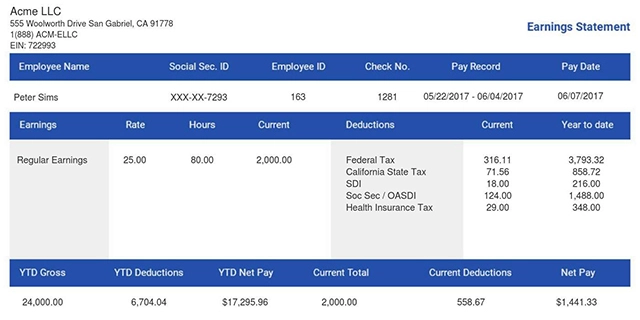
The catch shows up when a landlord or lender wants pay stubs you don't have. Schedule C, your 1040, client 1099s, and bank statements all help. Many owners also document draws with a paystub creator, so there's a clean record of what they actually paid themselves.
Can a Multi-Member LLC Be a Disregarded Entity?
Usually no. A multi-member LLC defaults to partnership treatment and files Form 1065 with a Schedule K-1 for each member. The one exception: spouses who own an LLC as community property in a community property state may treat it that way under Rev. Proc. 2002-69.
Outside those states, a husband and wife LLC files as a partnership. Adding a member later ends the status automatically, no form required.
Advantages and Disadvantages of Disregarded Entity Status
Advantages
- One tax return instead of two.
- No double taxation. Business income is taxed once, on your return.
- Business losses can offset your other income.
Disadvantages
- Self-employment tax applies to every dollar of profit, not just what you withdraw.
- You can't pay yourself a salary, which complicates income verification.
- Investors generally won't fund a single-member LLC without restructuring.
- State fees still apply. Plenty of states charge an annual LLC fee or franchise tax regardless of federal classification.
Liability protection comes from forming the LLC under state law, not from your tax status. Electing corporate treatment adds none.
Disregarded Entity vs S Corp: Changing Your Election
Two forms can end the status, and they point somewhere different. There's no disregarded entity election to make in the first place, since the status is the default, so what you're really filing is an election out of it. Is an S corp a disregarded entity? No, it files its own return. You'd use Form 8832 for corporate treatment or Form 2553 to go straight to S corp.
Timing is strict. The effective date can't be more than 75 days before you file or more than 12 months after. Once you change, you're locked out of electing again for 60 months.
The switch pays off once profit is high enough. At that point a reasonable salary plus distributions can save more self-employment tax than the added payroll and filing costs. Run your own numbers before electing.
You Might Also Like
- Self-Employed? Here's How to Show Proof of Income
- How to Create a Self-Employed Pay Stub
- Should Independent Contractors Receive a 1099 Pay Stub?
- W-9 vs W-2: What's the Difference?
- How to File Taxes With Your Last Pay Stub
Conclusion
Disregarded entities are invisible to the IRS for income tax while everyone else still treats them as real. Profit goes on your personal return, your LLC keeps its liability shield, and payroll runs under the company's own EIN once you hire. Get the W-9 right, plan for self-employment tax, and revisit the S corp math as profit grows. If you need pay documentation your own business won't issue you, a paystub generator creates professional records in minutes.
- 1. Enter Your Information

- 2. Select Your Favorite Theme

- 3. Download Your Stub!

 By
By