

Benefits of Automated Payroll System (2026 Guide)
 By
By
Payroll is the one back-office job where a small mistake becomes a legal problem and an unhappy employee in the same week. Miss a tax deposit and you owe a penalty. Miscalculate overtime and you owe back wages. That's why most small employers eventually weigh the benefits of automated payroll system adoption against the monthly fee. Others just need the document itself, which is what a pay stub generator is for.
This guide gives you the honest version. First, a plain definition and what the software actually does. Then the eight benefits that change your week. After that, a straight comparison against doing payroll by hand. Finally, what it costs, and whether a one-person business needs it at all.
Key Takeaways
- An automated payroll system calculates pay, withholds taxes, pays your team, and files the forms without spreadsheet math.
- The biggest wins are fewer errors, hours saved on every pay run, and records that satisfy IRS and DOL retention rules.
- Pricing is almost always a monthly base fee plus a per-employee charge, so your cost tracks headcount.
- One employee can be handled by hand. Multi-state work, overtime, or benefit deductions change that answer fast.
- What Is an Automated Payroll System?
- How Does Payroll Software Work?
- 8 Benefits of Automated Payroll System Adoption
- Benefits of Automated Payroll System vs Manual Payroll
- What to Look for in Payroll Automation Software
- How Much Does Payroll Software Cost?
- Benefits of Automated Payroll System for a Solo or Small Team
- The Payroll Automation Process: Switching in 6 Steps
- Risks and Limits of Payroll Automation
- Conclusion: The Benefits of Automated Payroll System in Plain Terms
What Is an Automated Payroll System?
An automated payroll system is software that calculates gross pay, tax withholding, and deductions. It then pays your team and files the resulting tax forms. No spreadsheet work sits in between. It also stores every pay record, generates pay stubs, and updates tax tables on its own.
That last part is what separates real payroll automation from a calculator. Plenty of tools will do the arithmetic. A true automated payroll system also remits the money, submits the filings, and keeps the paper trail.
Ask what is payroll software and you'll get one label covering two very different products. Some only compute, then hand you a file to upload yourself. Full-service products take on the tax deposits and filings as the provider of record. The second group costs more and removes far more risk.
How Does Payroll Software Work?

Payroll software pulls hours and salary data, applies federal, state, and local tax rules, and subtracts deductions to reach net pay. It then sends payments by direct deposit and generates a pay stub. It files your tax deposits, then rolls year-to-date totals into W-2s and 1099s at year end.
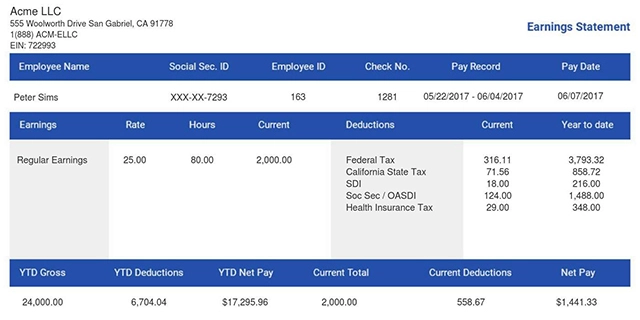
Here's what that covers task by task. Each item maps to a line you already recognize on a stub, right down to how your pay period is structured:
- Gross pay: regular hours, overtime, salary, commissions, and bonuses
- Tax withholding: federal income tax, Social Security, Medicare, and state or local tax
- Deductions: health premiums, retirement contributions, garnishments, and the payroll codes that label each one
- Employer taxes: the matching share you owe on top of wages
- Net pay and delivery: direct deposit files or printed checks
- Year-to-date totals: the running numbers that become year-end forms
That list is really the answer to what does payroll software do. Push it further and you get payroll accounting automation. Each run posts straight into your general ledger. You also get HR payroll automation, where a new hire's record flows into payroll with nobody retyping it.
8 Benefits of Automated Payroll System Adoption
These wins cluster into three groups: accuracy, time, and defensibility. Below are the eight that small and mid-sized employers notice first. Longer lists exist, but these eight are the ones that survive contact with a real pay run.
Fewer Mistakes on Every Run
Manual payroll breaks in predictable places. Someone fat-fingers an hours cell, applies last year's tax table, or forgets that an employee moved states. Software applies the same rules every cycle. It flags entries that don't add up before you approve them. Automation in payroll doesn't make you smarter; it makes you consistent, which is what accuracy actually is.
Hours Back on Every Pay Run
The clearest of the payroll automation benefits is simple arithmetic. The manual payroll process means gathering timesheets, calculating each person, cutting payments, and recording it all. The automation of payroll collapses that into reviewing numbers the system already produced. The point is to save time: an afternoon becomes a twenty-minute approval. It stays that way at four employees or forty.
Cleaner Tax Filing
Tax filing is where manual payroll gets expensive. Rates change, deposit schedules differ by employer size, and deadlines don't move for you. A full-service system calculates the deposit, sends it, and files the return. It matters more than it used to. The IRS now requires electronic filing once you hit 10 or more information returns in aggregate. That count combines W-2s and 1099s, so it pulls in even very small employers. It also spares you the January exercise of trying to calculate W-2 wages from a pay stub by hand.
Records That Hold Up in an Audit
You don't get to choose whether to keep payroll records. The IRS instructs employers to keep employment tax records for at least four years. The Department of Labor requires payroll records to be kept for at least three years under the Fair Labor Standards Act. An automated system stores every run as it happens. Producing three years of history becomes a search, not a hunt through a filing cabinet.
Stronger Data Security
Payroll data is the most sensitive file in a small business: Social Security numbers, bank details, and wages for everyone. A spreadsheet on a laptop has no access log and one backup at best. Payroll systems encrypt records, restrict access by role, and track who opened what.
Self-Service Access and Better Pay Stubs
This benefit rarely makes a feature list, and it's the one your employees actually feel. An automated system gives each person a portal for their own stubs and tax forms. That ends the endless "can you resend my paystub" email loop. Need pay documentation faster than your system delivers it? Our pay stub templates produce a clean, professional record in minutes.
Reporting You Can Actually Use
Manual payroll tells you what you paid. An automated one tells you what it means. Labor cost by department. Overtime trends before they become a budget problem. The true loaded cost of a hire. All of it comes out of data you already entered.
Room to Grow Without Rebuilding
Adding a fifth employee to a spreadsheet is fine. Adding a fifteenth in a second state is not. Automated systems absorb new hires, new states, and new pay types without a redesign. Global payroll automation extends the same idea across countries when you get there.
Benefits of Automated Payroll System vs Manual Payroll

Manual payroll isn't wrong. It's just expensive in ways that never show up on an invoice. Here's the honest comparison:
| Dimension | Manual Payroll | Automated Payroll |
|---|---|---|
| Time per run | Hours, and it grows with headcount | Minutes, and it stays flat |
| Error exposure | Every calculation is a chance to be wrong | Rules applied identically each cycle |
| Tax filing | You track deadlines and file yourself | Calculated, deposited, and filed for you |
| Recordkeeping | Manual filing and retention | Automatic, searchable, retained |
| Cost shape | Free in cash, paid in hours and penalties | Predictable monthly fee |
| Breaking point | Multi-state, overtime, benefit deductions | Scales past all three |
The automation of payroll system tasks pays off fastest for employers with hourly staff. Overtime and variable hours are exactly where hand calculation slips, which is why an overtime calculator is the first crutch most manual shops reach for.
How to Do Payroll Without Software
It's genuinely doable, and worth knowing before you buy. Get an EIN and each employee's Form W-4. Calculate gross pay from hours or salary. Look up current federal and state withholding tables, then compute each tax. Subtract deductions to reach net pay. Pay your team, then deposit withheld taxes on your assigned schedule. File quarterly Form 941 and issue W-2s in January. Check your state pay stub laws as well, because delivery rules vary. Doing that for one salaried person is manageable. Doing it for six hourly people across two states stops being worth your evening.
What to Look for in Payroll Automation Software
Feature lists all look identical on a pricing page. These separate the products once you're actually running payroll:
- Full-service tax filing. Confirm the provider files and deposits. Check whether they cover penalties caused by their own error.
- Multi-state support. Ask before you need it, not after your first remote hire. It helps to know what a provider like Paychex covers before comparing quotes.
- Contractor payments. A payroll automation system that handles W-2 employees but not 1099 contractors sends you back to manual work.
- Time tracking that connects. Hours should flow in without a CSV export.
- Employee self-service. Portal access to stubs and tax forms.
- Accounting integration. Each run should post to your ledger automatically.
- Real support. You want a person reachable in the 48 hours before payday.
Two terms deserve translation. Robotic process automation for HR and payroll means software bots that repeat rule-based clicks and data entry a human used to do. One example: moving records between two systems that don't talk to each other. Robotic process automation payroll setups mostly appear in large enterprises stitching legacy tools together. Under a hundred employees, a modern integrated platform gets you there without it. The benefits of automated payroll system software live in that checklist, not on the marketing page, so score every quote against those seven points before you compare prices. That's the short version of how to choose payroll software.
How Much Does Payroll Software Cost?
Payroll software is almost always priced as a flat monthly base fee plus a per-employee-per-month charge. Your bill scales with headcount, not with how often you run payroll. Tax filing is usually bundled. Year-end forms, multi-state filing, and benefits administration are the add-ons that most often cost extra.
Weigh the benefits of automated payroll system adoption against what it replaces, not against zero. Add up the hours you spend per run at your own billing rate. Then add the cost of one missed deposit penalty or a corrected W-2. For most employers past a handful of people, the subscription wins that comparison quickly. Ask about setup fees, per-state filing charges, and off-cycle run costs before signing. Those are where quotes drift.
Benefits of Automated Payroll System for a Solo or Small Team
Most payroll advice assumes you have an HR department behind you. Plenty of employers don't. When you're running payroll for one to nine people, the benefits of automated payroll system ownership are real but narrower. They concentrate in tax filing and recordkeeping, not in dashboards you'll never open. Those records are also what you reach for when someone requests employment verification and proof of income documents.
Do I Need Payroll Software for One Employee?
Not necessarily. A single salaried employee in one state, with no benefit deductions and no overtime, is a manageable manual job. Four things flip that answer. Hiring in a second state. Paying hourly staff who work overtime. Adding pre-tax benefit deductions. Crossing 10 total information returns, which lands you in the e-filing requirement. If you're asking do I need payroll software, and any of those four apply, the answer is yes. Past that point, the benefits of automated payroll system adoption stop being optional.
The Payroll Automation Process: Switching in 6 Steps
Switching is less about the software and more about the data you bring to it. Six steps, in order:
- Audit what you have now. Write down every step of your current run, including the ones only living in your head.
- Pick the provider. Match against the checklist above. Confirm they file in every state where you have workers.
- Clean your data first. Employee details, wage rates, deductions, and year-to-date totals. Migrating bad data just automates the errors.
- Load year-to-date figures. If you switch mid-year, these have to be exact or your W-2s will be wrong in January.
- Run both systems in parallel for one cycle. This is the highest-value step and the one most people skip. Process the same pay period the old way and the new way. Reconcile to the penny before you cut over.
- Train your payroll team and go live. Show employees the new system on day one, because that's the change they'll actually notice.
Handled in that order, the payroll automation process is far less disruptive than people expect. Knowing how to use payroll software well then comes down to one habit: review the preview report before you approve, every single time.
Risks and Limits of Payroll Automation
The limits on the benefits of automated payroll system adoption are worth naming up front. Bad inputs still produce bad paychecks; the system trusts the hours you feed it. Integrations break quietly, usually after one of the connected tools updates. Over-trust is the subtle one, where nobody reviews the preview because the software supposedly handles it. A provider outage during payroll week is out of your hands, so keep a manual fallback documented.
You Might Also Like
- How to Get a Pay Stub From Direct Deposit
- FIT Taxable Wages Explained
- Payroll vs Compensation: What's the Difference?
- Should Independent Contractors Receive a 1099 Pay Stub?
- Payday, Pay Cycle, and Pay Period: The Difference
Conclusion: The Benefits of Automated Payroll System in Plain Terms
Strip away the enterprise sales language and three things remain. You make fewer mistakes. Your time comes back. And when someone asks what you paid, you can prove it. That's the whole case for the benefits of automated payroll system adoption. Manual payroll works until complexity arrives, and complexity always arrives.
If you need professional pay documentation right now, before any system is in place, our paystub generator creates accurate, professional pay stubs in minutes.
- 1. Enter Your Information

- 2. Select Your Favorite Theme

- 3. Download Your Stub!


 By
By