What Are Payroll Deductions? Types and Examples (2026)
 By
Your offer letter says $52,000 a year. Your first deposit says something much smaller. So what are payroll deductions, and where does the rest of the money go? They are the taxes and benefits taken out of each paycheck before you get paid. This guide covers every type. It shows the math with 2026 numbers and how to read each line on your pay stubs. It is for workers checking their pay and for small business owners who run payroll.
Key Takeaways
- Payroll deductions turn gross pay into net pay, the amount you take home.
- Federal income tax, Social Security, and Medicare come out of nearly every US paycheck.
- Pre-tax deductions like a traditional 401(k) lower your taxable income.
- Your pay stub lists each deduction by code, along with year-to-date totals.
What Are Payroll Deductions?
Payroll deductions are amounts an employer takes out of an employee's gross pay before the paycheck is issued. Some are required by law, like federal income tax, Social Security, and Medicare. Others are chosen by the worker, like health insurance or 401(k) savings. What is left after every deduction is your net pay.
In payroll textbooks, amounts withheld from an employee's gross pay are called deductions. The simplest payroll deductions definition is money that leaves your check before it reaches you.
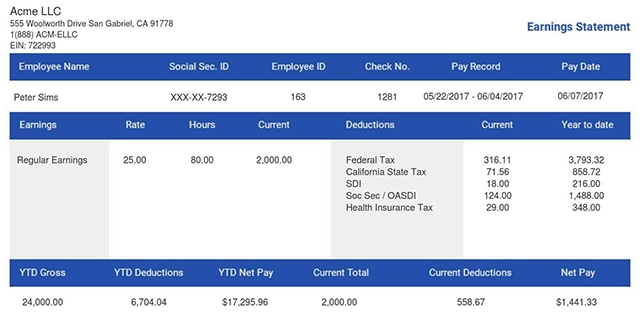
So what is a payroll deduction in practice? It is one line on your pay stub. Each line has a name, a current amount, and a year-to-date total. The employer does not keep this money. Tax amounts go to the IRS and state agencies. Benefit amounts go to insurers, retirement plans, or unions. For small businesses, each deduction also becomes an accounting entry that has to match what was paid out.
Types of Payroll Deductions

There are two main groups. Mandatory deductions are set by law. Voluntary deductions are ones the employee agrees to. Each one is also pre-tax or after-tax. That changes how much tax you owe.
Here are common payroll deductions and how they are treated:
| Deduction | Mandatory or Voluntary | Tax Treatment |
|---|---|---|
| Federal income tax | Mandatory | Not applicable |
| Social Security and Medicare | Mandatory | Not applicable |
| State and local income tax | Mandatory where charged | Not applicable |
| Wage garnishment | Mandatory by court order | After-tax |
| Health, dental, vision insurance | Voluntary | Usually pre-tax |
| Traditional 401(k) | Voluntary | Pre-tax |
| Roth 401(k) | Voluntary | After-tax |
| Union dues, charity gifts | Voluntary | After-tax |
These payroll deduction examples cover most stubs you will see. Some jobs add others, like uniform rentals or parking.
Mandatory Payroll Deductions
Mandatory payroll deductions are taxes and court orders that employers must withhold. An employee cannot opt out of them. A business that skips them can owe the missed tax plus penalties.
Federal Income Tax (FIT)
On your stub, the FIT payroll deduction is the money sent to the IRS each payday. The amount depends on your pay, your pay schedule, and the Form W-4 you gave your employer. The taxable wages for FIT are your pay minus pre-tax items. Employers figure it out with the withholding tables in IRS Publication 15-T.
Social Security and Medicare (FICA)
Every payday, two payroll tax deductions go toward federal retirement benefits and hospital insurance for people 65 and older. Workers pay 6.2% for Social Security on wages up to $184,500 in 2026. The OASDI payroll deduction is the same Social Security tax, listed under its formal name, Old-Age, Survivors, and Disability Insurance. Medicare is 1.45% on all wages, plus 0.9% on wages over $200,000. Employer payroll deductions mirror this, since the business pays a matching 6.2% and 1.45%.
State and Local Income Taxes
Federal payroll deductions are the same in every state, but state rules vary. Most states charge an income tax, and some cities add their own. Nine states have no wage income tax, including Texas and Florida. A few states also take money for disability or paid leave programs.
Wage Garnishments
A garnishment is a court or agency order to take part of your pay for a debt. Child support, unpaid federal student loans, and back taxes are common reasons.
Voluntary Payroll Deductions

Voluntary deductions are ones the employee signs up for. Most need your written consent. You can usually change them during open enrollment.
Common voluntary choices include:
- Health insurance premiums for medical, dental, and vision plans
- Retirement savings in a 401(k) or 403(b), up to $24,500 in 2026
- Health accounts like an HSA ($4,400 self or $8,750 family in 2026) or a health FSA ($3,400)
- Life and disability insurance beyond what the employer provides
- Union dues and charitable gifts
- Loan repayments or wage advances owed to the employer
A worker might add a dental plan in January and see a smaller check the next payday. A business owner needs each signed form on file before taking the first dollar.
Pre-Tax vs. After-Tax Payroll Deductions
Pre-tax payroll deductions come out before income tax is figured. That lowers your taxable income, so you pay less tax now. After-tax payroll deductions come out once taxes are calculated, like any post-tax deduction, so they do not cut your tax bill today.
| Pre-Tax Deductions | Post-Tax Deductions | |
|---|---|---|
| When taken | Before income tax | After all taxes |
| Effect on tax | Lowers taxable income | No change |
| Examples | Traditional 401(k), Section 125 health premiums, HSA | Roth 401(k), union dues, garnishments |
One detail trips people up. Health premiums paid through a Section 125 plan skip income tax and FICA. A traditional 401(k) skips income tax, but Social Security and Medicare still apply. So a 401(k) helps your income tax but not your FICA.
How to Calculate Payroll Deductions
To calculate payroll deductions, work in this order:
- Start with employee gross pay for the period.
- Subtract pre-tax deductions.
- Figure FICA, federal, state, and local taxes on what remains.
- Subtract after-tax deductions.
- The rest is net pay.
Here is an example for a single worker paid $2,000 every two weeks:
| Step | Amount |
|---|---|
| Gross pay | $2,000.00 |
| Traditional 401(k), 5% (pre-tax) | -$100.00 |
| Health premium (pre-tax) | -$75.00 |
| Social Security, 6.2% of $1,925 | -$119.35 |
| Medicare, 1.45% of $1,925 | -$27.91 |
| Federal income tax (estimate) | -$135.00 |
| State income tax, 4% example rate | -$73.00 |
| Union dues (after-tax) | -$20.00 |
| Net pay | $1,449.74 |
FICA uses $1,925 because only the health premium skips those taxes. Your federal tax withholding will vary with your W-4.
A tip from experience: do not compare two jobs on net pay alone. A smaller check can mean more money going into savings, not more tax. Check your stub again after any W-4 change or open enrollment.
Payroll Deduction Codes on Your Pay Stub
Pay stubs use short labels to save space, much like other payroll codes. Payroll deduction codes vary by provider, but these are common:
| Code | Meaning |
|---|---|
| FIT or FWT | Federal income tax |
| SIT or SWT | State income tax |
| OASDI or SS | Social Security |
| MED or FICA-M | Medicare |
| 401K | Traditional 401(k) |
| HLTH or MED INS | Health insurance |
| GARN | Wage garnishment |
The year-to-date column shows totals since January 1. Landlords and lenders often check it when you apply for an apartment or a loan. Save every stub as a PDF. If you earn more than $184,500, your Social Security line should stop once you pass that amount.
Illegal Payroll Deductions: What Employers Can't Take
Not every deduction is allowed. Federal law limits what an employer can take, and many states go further.
- Minimum wage floor. Some deductions mainly help the employer, like uniforms, tools, or a cash shortage. These cannot push a non-exempt worker below $7.25 an hour.
- Garnishment caps. For most debts, the limit is 25% of disposable earnings, per the Department of Labor. Child support can take up to 50% to 65%. It helps to know what a garnishment looks like on a pay stub.
- Consent rules. Many states require written approval for any deduction that is not a tax or court order.
Illegal payroll deductions can lead to back pay claims. Business owners should check with their state labor office first.
You Might Also Like
- How to Read Pay Stub Deduction Codes
- What FICA Stands For
- Payroll Tax vs Income Tax
- Mandatory Deductions From Your Paycheck
- Pay Stub Deductions Explained
Conclusion
Payroll deductions explain the gap between what you earn and what you take home. Mandatory taxes come first, voluntary benefits follow, and pre-tax choices can lower your tax bill. Workers should read each line of their stub. Business owners should keep every deduction accurate and on file. Need clear records? Use our pay stub generator. It creates professional pay stubs with every deduction listed in minutes.
- 1. Enter Your Information

- 2. Select Your Favorite Theme

- 3. Download Your Stub!

 By