

Payroll Outsourcing Process: How to Outsource Payroll in 7 Steps
 By
By
Payroll expands to fill whatever time you give it. You calculate hours, withhold the right taxes, hit deposit deadlines, and file quarterly returns. A business with a handful of employees can lose a full day every pay period to work that earns nothing. That's usually when the payroll outsourcing process starts to look worth understanding.
Handing payroll to an outside provider isn't complicated, and it doesn't change your duty to keep accurate pay records. It's easy to do badly, though. Switch at the wrong point in the year and you lose your year-to-date totals. Skip the verification step and you learn about a missed tax deposit when the penalty notice arrives.
This guide covers what payroll outsourcing is and how it works. It walks through the seven steps of moving payroll to a provider, what it costs, and where the risks sit. It also covers how to handle the switch without leaving your team without pay records.
Key Takeaways
- Payroll outsourcing means paying an outside company to calculate pay, move the money, deposit payroll taxes, and file the returns.
- The payroll outsourcing process runs in seven stages, from auditing your current setup to verifying your first tax deposit after go-live.
- Expect a base fee per pay run plus a per-employee charge, with year-end forms usually billed separately.
- The IRS holds you responsible for your employment taxes even after you outsource. Customers of a Certified Professional Employer Organization are relieved of that liability in certain situations.
- Switch at a quarter or year boundary, and always run one payroll cycle in parallel before going live.
- What Is the Payroll Outsourcing Process?
- How Does the Payroll Outsourcing Process Work?
- What Payroll Outsourcing Services Typically Include
- The Payroll Outsourcing Process in 7 Steps
- Benefits of Outsourcing Payroll
- Risks in the Payroll Outsourcing Process (and Who Stays Liable)
- How Much Does Payroll Outsourcing Cost?
- In-House Payroll vs Payroll Software vs Outsourcing
- How to Choose a Payroll Outsourcing Company
- Making the Transition Without Breaking Payroll
- Conclusion: Getting Your Payroll Outsourcing Process Right
What Is the Payroll Outsourcing Process?
Payroll outsourcing is hiring an outside company to run some or all of your payroll. That covers calculating pay, issuing direct deposits, withholding and depositing payroll taxes, and filing the related returns. You still approve hours and pay rates. The provider handles the math, the money, and the paperwork behind each pay period.
There's an important line to draw early. When people ask what is payroll outsourcing, they often mean payroll software, which is a different thing. Payroll management tools help you do the work yourself. Outsourcing hands the work to someone else. Many businesses start with software and move to a provider later, once compliance takes more attention than the payroll itself.
How Does the Payroll Outsourcing Process Work?

You send the provider your hours, salaries, and any changes before each pay period. They calculate gross pay, taxes, and deductions, move money to your employees, deposit withheld taxes with the IRS and state agencies, and generate pay stubs. You review and approve the payroll register before anything is paid.
So how does payroll outsourcing work day to day? The rhythm is simple. A few days before payday you submit hours and flag anything unusual, like a bonus, a new hire, or a termination. The provider sends back a draft payroll register. It shows gross pay, every withholding, and net pay per person. Once you approve it, they pull the funds from your account, send direct deposits, and schedule the tax deposits.
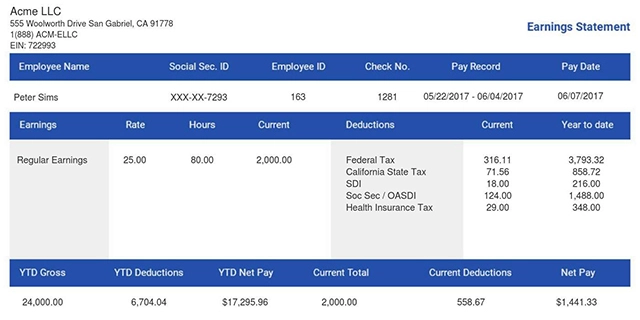
For your employees, the visible change is where the pay stub comes from. Stubs usually move to the provider's employee portal. That matters more than it sounds. A worker applying for an apartment or a car loan needs recent pay stubs on short notice. Portal access is the thing most likely to break during a switch.
What Payroll Outsourcing Services Typically Include
Scope varies, so confirm line by line what you're buying before you begin the payroll outsourcing process. Most payroll outsourcing services cover:
- Gross-to-net pay calculation for hourly and salaried staff
- Direct deposit and pay card processing
- Federal, state, and local tax withholding and deposits
- Quarterly and annual payroll tax returns
- Year-end forms such as W-2s and 1099s
- New-hire reporting to your state
- Wage garnishment and child support orders
- Pay stub generation and employee portal access
Outsourcing payroll services at the low end sometimes stop at payroll processing and direct deposit. Tax filing stays with you. Payroll providers differ widely in which payroll functions they actually take on. That narrower arrangement is sometimes sold as payroll processing outsourcing, and it's a very different product. It's also the mix-up people make most often when they compare quotes.
The Payroll Outsourcing Process in 7 Steps

Here's where most guides stop short. The payroll outsourcing process isn't a single decision. It's a sequence, and the order matters.
Step 1: Audit Your Current Payroll and What It Actually Costs
Write down the hours you or your bookkeeper spend per pay period. Multiply it by an honest hourly rate. Then add anything you've paid in penalties or amended returns over the past two years. Most owners are surprised by the total. That number is what you compare quotes against, not zero.
Step 2: Decide What You're Outsourcing
Full-service outsourcing covers calculation, payment, tax deposits, and filings. Partial arrangements keep some of that in-house. Decide before you shop. Scope drives price, and it's the variable providers flex to look cheaper.
Step 3: Shortlist Providers
Look at national payroll bureaus, professional employer organizations, and local accounting firms that run payroll for clients. It helps to know what a payroll provider actually does before you compare them. Three quotes is usually enough. Match them on identical scope so the numbers actually compare.
Step 4: Check Credentials and Confirm Who Carries the Liability
Ask if the provider is a reporting agent or a Certified Professional Employer Organization. The answer decides who the IRS chases if taxes go unpaid. Ask for references from businesses your size, and check that they carry insurance.
Step 5: Migrate Your Payroll Data
The provider needs employee information: pay rates, deduction and benefit choices, and tax withholding choices. They also need year-to-date totals and tax withholding details for every employee. Those year-to-date figures cause the most trouble. If they transfer wrong, your W-2s will be wrong at year end.
Step 6: Run One Cycle in Parallel
Before going live, run one full payroll both ways: your current method and the provider's. Match the two results to the cent. Any gap is a setup error. It's far cheaper to find it now than in an amended quarterly return.
Step 7: Go Live, Then Verify the First Tax Deposit
Most owners stop once the first payroll clears. That's one step too early, because a missed deposit stays your problem. The IRS encourages employers to enroll in the Electronic Federal Tax Payment System and to confirm their provider uses it. Enrollment is free, and it shows you the payment history under your own Employer Identification Number. That's how you check your provider's work instead of assuming it.
Benefits of Outsourcing Payroll
Most owners outsource to save time, and that gain is real. A payroll run that ate half a day becomes a fifteen-minute review.
The quieter benefits matter more over a few years:
- Penalty avoidance. Payroll tax deadlines are strict, and penalties compound. A provider built around those dates will hit them more often than a busy owner.
- Compliance that stays current. Payroll thresholds move every year. The Social Security wage base is $184,500 for 2026, up from $176,100 the year before, and Medicare has no wage cap at all. Tracking those shifts is the provider's job.
- Scalability. Going from four employees to fourteen adds more than headcount. It adds pay rates, deduction elections, and chances to miscalculate. With a provider, it's a line item change.
- Continuity. If your bookkeeper leaves, payroll doesn't stop.
The advantages of outsourcing payroll are clearest for businesses with hourly staff, variable schedules, or employees in more than one state. Those are the setups where in-house errors pile up.
For an employee, the upside is consistency. Pay arrives on schedule and stubs land in the same place every period. That makes proving income for a lease or a loan much easier.
Risks in the Payroll Outsourcing Process (and Who Stays Liable)
This is the part most guides skip, and it's the part with real money attached. It starts with knowing who is responsible for the payroll.
Outsourcing payroll doesn't outsource your tax liability. The IRS states that employers are ultimately responsible for income tax withheld. That responsibility also covers both the employer and employee portions of Social Security and Medicare taxes. If your provider takes your money and fails to make the tax payments, the IRS still comes to you.
There's one narrow exception. The IRS says that in certain situations, customers of a Certified Professional Employer Organization are relieved of that liability for income tax withholding and Social Security and Medicare taxes. Note the qualifier. The relief depends on the arrangement, so it doesn't apply automatically just because a provider holds the certification. If liability transfer matters to you, ask about that certification specifically and get in writing what it covers, rather than assuming it.
The distinction between payroll tax and income tax matters here too, since both flow through the same deposits. Signing IRS Form 8655 to appoint a reporting agent doesn't shift liability either. It authorizes the agent to act for you. It doesn't make them the responsible party.
There are other drawbacks worth weighing. Outsourcing payroll pros and cons come down to three things: less control over timing, a cost that grows with headcount, and reliance on one vendor.
How Much Does Payroll Outsourcing Cost?
Most providers price payroll in two parts: a flat base fee per pay run plus a per-employee charge. Expect roughly $20 to $100 per run as the base, plus about $4 to $12 per employee, with year-end tax forms and add-ons billed separately. Running payroll less often lowers your total cost.
Cost is usually the deciding factor in the payroll outsourcing process. Three components drive the payroll outsourcing cost:
- Base fee per run. Charged whether you have three employees or thirty, and sometimes billed as a flat monthly fee.
- Per-employee, per-run fee. The part that scales with your number of employees.
- Add-ons. Year-end W-2 and 1099 preparation, multi-state filing, garnishment handling, and time-tracking add-ons are often separate.
Here's a worked example. Ten employees paid twice a month, at a $50 base fee plus $8 per employee, comes to $130 per run. That's roughly $3,120 a year before year-end forms. Move the same team to monthly pay and you halve the number of base fees.
Compare that to your number from Step 1, not against zero. Vendor-published payroll outsourcing statistics tend to flatter the vendor, so weigh them against your own figures. Pay frequency is often the cheapest lever you control.
In-House Payroll vs Payroll Software vs Outsourcing
There are three options here, not two. Payroll software sits in the middle.
| In-House Manual | Payroll Software | Outsourcing | |
|---|---|---|---|
| Who calculates | You | You, automated | Provider |
| Who files taxes | You | You, or software add-on | Provider |
| Typical cost | Your time | Low monthly subscription | Base fee plus per-employee |
| Error risk | Highest | Moderate | Lowest |
| Best for | 1-2 employees, simple pay | Comfortable with compliance | Limited time or multi-state staff |
Payroll outsourcing software isn't really its own category. It's either software you operate or a service someone operates for you. Many businesses land on a middle path. They keep software for time tracking and pay calculation, then outsource tax filing. Those are the payroll outsourcing solutions that suit owners who want oversight without the tax risk.
Payroll outsourcing trends move constantly, but the right choice depends on your headcount rather than the market. The payroll outsourcing process isn't the right answer for every business. Stay in-house if you have one or two salaried employees in a single state and you file reliably. Outsource once you have hourly staff, multiple states, or a filing deadline you've already missed.
How to Choose a Payroll Outsourcing Company
Step 3 of the payroll outsourcing process is where the real comparison work happens. Not all payroll companies manage payroll the same way. Evaluating payroll outsourcing companies gets easier when you ask each one the same questions:
- Are you a reporting agent or a Certified Professional Employer Organization, and who's liable if a deposit is missed?
- Do you file federal, state, and local returns, or only some of them?
- What's included, and what's billed separately?
- Do you use EFTPS, so I can verify deposits under my own EIN?
- What are your data security practices, and who can see employee information?
- What happens to my data and my employees' pay stub history if I leave?
- Who handles a payroll correction, and how fast?
Those last two matter more than most buyers expect. Exit terms and access to old pay records rarely come up during a sale. They're painful to discover later.
Payroll outsourcing for accountants works a little differently. If you run payroll on behalf of clients, ask if the provider allows multi-client access under one login. If you want benefits handled too, HR and payroll outsourcing arrangements bundle benefits administration, and sometimes hiring paperwork, with the pay run. Payroll and benefits outsourcing packages work the same way. Bundling is convenient and often cheaper than buying the pieces separately, but it's harder to unwind later. A dedicated payroll outsourcing provider is usually simpler to exit than a bundled one.
Making the Transition Without Breaking Payroll
The final stage of the payroll outsourcing process is the handoff, and timing decides how painful it gets. Moving at the start of a calendar year is cleanest. Year-to-date totals start at zero, and W-2s come from one source. The start of a quarter is the next best option. Mid-quarter switches create clean-up work and amended returns.
Tell your team before anything changes, not after. Employees need to know the pay date isn't moving and how to log in. Show them how to get a pay stub from direct deposit once the new portal is live. A worker who can't produce a recent pay stub during a lease application will escalate it to you, on a deadline.
Keep your own copies through the changeover. Export the last twelve months of pay records before the old system goes dark. Make sure your team can still reach historical stubs afterward. If portal access lags during setup, having accurate stub records on hand keeps everyone moving.
If an employee needs proof of income while the portal is still being set up, don't make them wait on the provider. You can generate an accurate stub from your own payroll data the same day, which keeps a lease or loan application on track.
Finally, watch the first two runs closely. Check net pay against the parallel run, confirm the tax deposit posted, and check it against your bank statement.
Conclusion: Getting Your Payroll Outsourcing Process Right
Done well, outsourcing removes a recurring admin job and cuts your exposure to filing penalties. Done carelessly, it creates clean-up work that shows up at year end. The difference comes down to four things. Audit your real costs first. Confirm who carries the tax liability. Run one cycle in parallel, and verify that first deposit yourself.
Accurate pay records matter at every step of the handoff, for your records and for your employees. Create professional pay stubs in under two minutes at ThePayStubs.com, with automatic tax calculations and no subscription required.
You Might Also Like
- 1. Enter Your Information

- 2. Select Your Favorite Theme

- 3. Download Your Stub!

 By
By