

How To Get a Pay Stub From Any Employer (2026)
 By
By
Pay stubs are among the most requested proof-of-income documents in the U.S. Landlords ask for them on rental applications. Lenders also need them for mortgages and auto loans. If you need to know how to get a pay stub quickly, you can start with your employer's payroll portal.
Knowing how to get a pay stub from your current employer usually takes minutes. Tracking down pay stubs from a previous job takes more. It requires a written request, the right human resources contact, and a follow-up plan.
The process depends on your employer's payroll software and how long ago you left. Small business owners who need to provide pay stubs for employees face a similar challenge.
This guide shows you how to get a pay stub from any employer, plus what to do when a former employer won't respond or a company has closed.
Key Takeaways
- Pay stubs are available through your employer's payroll portal, HR department, or by direct written request
- Former employees can request pay stubs in writing. Most employers respond within 5–10 business days
- If a former employer refuses to comply, file a complaint with your state's Department of Labor
- Self-employed workers and contractors can generate professional pay stubs instantly at ThePayStubs.com
What Is a Pay Stub?
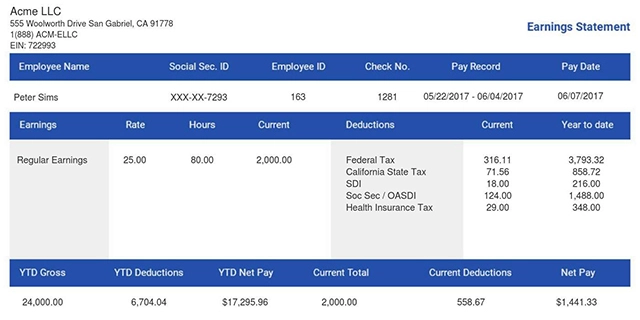
A pay stub (also called a wage statement, earnings statement, paycheck stub, or pay slip) is a document your employer issues each pay period. It lists your gross earnings, payroll deductions, federal income tax withheld, and net take-home pay. You can find it attached to your paycheck or in your employer's payroll portal.
Pay stubs show personal details like your name, address, and Social Security Number (often masked). Store them safely to guard against identity theft.
What Information Is on a Pay Stub?
Every pay stub has a standard set of fields. The layout varies by employer and payroll service. Here's what you'll find:
-
Employee and employer info: Full name, address, and masked SSN; employer name and EIN
-
Pay period dates: Start and end dates for the work period
-
Gross pay: Total earnings before deductions, including wages, overtime pay, and bonuses
-
Tax withholdings: Federal and state income tax withheld for the pay period
-
FICA taxes: Social Security (6.2%) and Medicare (1.45%)
-
Benefit deductions: Health insurance premiums, 401(k) contributions, paid time off accruals, FSA, and other voluntary deductions
-
Wage garnishments: Court-ordered deductions, if applicable
-
Net pay: Your take-home pay after all deductions are applied
-
Year-to-date (YTD) totals: Cumulative totals for all fields since January 1
Some states require extra details. California, for example, makes employers list paid sick leave balances on every pay stub.
How To Get a Pay Stub From Your Current Employer

Most employees access electronic pay stubs through their employer's employee portal (ADP, Workday, Gusto, or Paychex). If you do not have portal access, contact your HR or payroll department to request copies.
1. Through Your Employer's Payroll Portal
Most companies use a payroll provider with a self-service employee login. To download your pay stubs:
- Log in using the credentials your employer originally provided
- Navigate to "Pay," "Payroll," or "My Pay" in the portal
- Select the pay period you need and download the PDF
If your login was deactivated, contact HR to restore access. With direct deposit, stubs are typically available the day before or on payday.
2. By Requesting From HR or Payroll Directly
Some companies don't offer self-service portals. Former employees often find that their access has expired. In either case, contact the payroll department by email or phone. Specify the pay periods you need. Allow 1–2 business days for email, 2–3 days for paper. If you run a small business, most payroll services auto-generate pay stubs for your team with each payroll run. If you would rather compare tools first, our review of the PayStubHero paystub generator covers a popular alternative.
How To Get Paystubs From an Old Job
If you need to know how to get paystubs from old job records, the process is simple. Email the HR or payroll department with your full name, the last 4 digits of your SSN, your employee ID, and the pay period dates. Most employers respond in 5–10 business days.
If you've recently switched jobs and need to know how to get pay stubs from previous employer systems, here are six steps. They cover both paths of checking if an old portal still works and contacting HR.
1. Locate the Right Contact
Reach out to HR or payroll/accounting, not your former manager. Check the company website or LinkedIn for current contact details.
2. Try the Old Employee Portal First
If your past employer used ADP, Workday, Gusto, or Paychex, your login may still work for 30–90 days. Download your employment records before access expires.
3. Send a Formal Written Request
Email is best. It creates a paper trail. Include your full name, the last 4 digits of your SSN, employee ID (if known), dates of employment, and the pay periods you need.
4. Use This Email Template
- Subject: Pay Stub Request, [Your Name].
- Body: "Dear HR/Payroll Team, I am requesting copies of my pay stubs for the period [start date] through [end date]. My identifying information: Full Name: [Name] | Last 4 SSN: [XXXX] | Employee ID: [XXXX] | Employment Dates: [Dates]. Please send to [your email]. Thank you."
5. Follow up After 10 Business Days
A polite follow-up usually moves things along. If you're wondering how to request pay stubs from previous employer systems, email requests are filled in 2–5 days. Mailed requests take 5–10 business days.
6. Know Your Rights
Many states require employers to give copies of pay stubs on request. Refusal can be a wage record violation under state law. You have legal options if they refuse.
What If the Company Has Closed or Was Acquired?
Business closures don't always mean your records are lost. Figuring out how to get old pay stubs from previous employer files is harder when the business no longer exists, but options remain. Records may have gone to a bankruptcy trustee or a successor company.
For acquisitions, contact the new company's HR department. Payroll records usually transfer. As a last resort, use the free IRS "Get Transcript" tool at IRS.gov to access your W-2 and wage data.
What To Do if Your Former Employer Won’t Comply
File a complaint with your state labor department or the Department of Labor at dol.gov. Many states treat failure to give payroll records as a wage violation. The employer faces financial penalties.
In California, employers must respond to a pay stub request within 21 days or face a $750 fine per employee. The EEOC also tracks employer compliance with record-keeping rules.
Alternatives When You Can't Get Your Pay Stubs
If you still can't figure out how to get a pay stub from a former employer, or you were self-employed, these documents are widely accepted as proof of income:
- Bank statements: Direct deposit records showing your pay amounts. Most lenders and landlords accept 2–3 months of recent statements.
- IRS Wage and Income Transcript: Free to download at IRS.gov via "Get Transcript." Shows W-2 and wage data for any prior year.
- Form W-2: Your annual wage and tax statement, accepted by virtually all lenders as an income record.
- Employment verification letter: Often easier to get from a former employer than pay stubs. Most landlords and lenders accept them.
- Pay stub generator: Freelancers and independent contractors who never got employer-issued stubs can create professional pay documentation at ThePayStubs.com.
Do Employers Have To Provide Pay Stubs?
No federal law requires employers to issue pay stubs. The Fair Labor Standards Act (FLSA) only requires that employers keep payroll records for at least 3 years. If you're wondering how to obtain pay stubs from previous employer records, state law is where your rights come from.
Most states have their own rules. Access states must give electronic or paper stubs. Access/print states (California, Colorado, Hawaii, Texas, and Washington) let workers view and print stubs. States like Alabama, Florida, and Georgia have no pay stub law. Knowing how to get a pay stub in your state starts with checking your Department of Labor website for 2026 rules.
You Might Also Like
- Self-Employed? Here's How to Show Proof of Income
- How to Tell the Difference Between a Real and Fake Pay Stub
- How to Read a W-2 Like a Pro
- Employment Verification Letter
- Paycheck Stubs
Conclusion
Learning how to get a pay stub from an employer takes minutes. Log in to your payroll portal or send a quick request to HR. Getting pay stubs from a previous employer takes more effort. For this, you can write a formal request, send it to the right contact, and follow up. If a former employer won't cooperate, your state's Department of Labor has tools to help. When stubs aren't available, bank statements, IRS transcripts, and W-2s work as income documentation. We have also reviewed FormPros, a popular third-party tool, and how it compares to our generator.
For self-employed workers, freelancers, and small business owners who need pay documentation, use our pay stub generator at ThePayStubs.com to create professional pay stubs in minutes.
- 1. Enter Your Information

- 2. Select Your Favorite Theme

- 3. Download Your Stub!

 By
By