

How To Fill Out a W4 in 2026: Step-By-Step Guide
 By
James Wilson
By
James Wilson Learning how to fill out a W4 starts with one fact. This form sets the amount of federal income tax your employer deducts from each paycheck.
When it’s gotten right, you’ll either break even at tax time or receive a small tax refund. When it’s not, you could end up owing money in April or giving the government an interest-free loan throughout the year.
This guide walks you through all five steps of the 2026 W4, the latest updates, common mistakes, and when to submit a new form. It covers filling out a W4 for the first time as a new employee and for small business owners who use ThePayStubs.com to manage payroll and generate pay stubs.
Key Takeaways
- A W4 (Form W-4), the Employee's Withholding Certificate, tells your employer how much federal income tax to withhold from each paycheck
- Steps 1 and 5 are required for all employees. Steps 2 through 4 only apply in certain cases
- The 2026 W4 raises the Child Tax Credit to $2,200 per qualifying child (up from $2,000) and expands the Deductions Worksheet from 5 to 15 lines
- Use the IRS Tax Withholding Estimator at irs.gov for the most accurate result
- Update your W4 any time your income, family size, or filing status changes
- What Is a W4 Form?
- How To Fill Out a W4 in 2026: Step-By-Step
- What's New on the 2026 W4 Form
- When Should You Fill Out a New W4?
- How To Adjust Your W4 To Get More or Less Tax Withheld
- W-2 vs. W4: What's the Difference?
- Mistakes To Avoid When You Fill Out a W4
- Using the IRS Tax Withholding Estimator
- You Might Also Like
- Conclusion
What Is a W4 Form?
A W4 is the Employee's Withholding Certificate. It tells your employer how much federal income tax to withhold from each paycheck. You fill it out when starting any new job or when your tax situation changes. It never goes to the IRS. Your employer keeps it on file. Once you know how to fill out a W4, you can update it at any time.
What does a W4 look like? The 2026 federal W-4 form has five sections. They include:
- Personal info
- Multiple jobs or a spouse works
- Dependents
- Other adjustments
- Your signature
Unlike the W-2 form, the W4 is what you fill in to set your withholding amount. Your employer sends you a W-2 each January to show what was actually withheld.
If you're looking for a 2023 W-4 form example filled out, note that the 2026 version has changed. The IRS updated credits, deductions, and the exemption process. Any 2024 W-4 form example filled out before these updates is also outdated. Use the current form for accurate results.
How To Fill Out a W4 in 2026: Step-By-Step
Here is how to fill out a W4 step by step. Work through the five steps in order, since each step builds on the previous one. Based on your situation, you may only need to complete certain steps. Below is a W4 form example that walks through each section. Here is how to complete W4 sections one at a time.
Step 1: Enter Your Personal Information
Step 1 is required for every employee. Enter your full legal name as it appears on your Social Security card. Add your home address and Social Security number. Then check one filing status box:
- Single or Married Filing Separately
- Married Filing Jointly or Qualifying Surviving Spouse
- Head of Household: For unmarried filers who pay more than half the costs for a qualifying person in their home.
A single teacher starting at a new school in 2026 enters their name as shown on their Social Security card. They check "Single or Married Filing Separately." If they are unmarried with a dependent child at home, they check "Head of Household" instead. This is the simplest part of how to fill out W4 single.
Step 2: Multiple Jobs or Spouse Works
Step 2 applies only if you hold more than one job at the same time. It also applies if you are married filing jointly and your spouse works. If neither applies, leave Step 2 blank.
Choose one option only:
-
Option (a): IRS Tax Withholding Estimator: The most accurate option. Required if you or your spouse has self-employment income. The tool gives the exact dollar amount to enter in Step 4(c) based on your FIT taxable wages.
-
Option (b): W4 Multiple Jobs Worksheet: Complete the worksheet on page 3 of the W4. It uses a table to estimate the extra tax you owe when income comes from more than one source. This is the same form that the IRS Multiple Jobs Worksheet references in the instructions. For example, say you earn $50,000 at your main job and $18,000 part-time as a single filer. Find $50,000 in the left column, cross-reference $18,000 across the top, and enter that value in Step 4(c).
-
Option (c): Check the Box: The simplest option. Only works if you have exactly two jobs with roughly equal pay.
Important: If you use Step 2, fill out Steps 3 and 4 only on the W4 for the highest-paying job.
Step 3: How To Claim Dependents on W4
Step 3 reduces your withholding by the value of tax credits you qualify for. It applies if your total household income is $200,000 or less ($400,000 or less for married filing jointly).
The W4 dependent amount for 2026 works as follows.
- Qualifying Children Under 17: Multiply the number of qualifying children by $2,200 (up from $2,000 in 2025) and enter on line 3(a).
- Other Dependents: Multiply the number of other dependents by $500 and enter on line 3(b).
- Add both lines together and enter the total on line 3
The dependent amount on W4 line 3(a) directly lowers your withholding. A new parent with one child under 17, earning $75,000, enters $2,200. Their employer adjusts withholding downward.
When married filing jointly, who claims dependents on the W4? Only one spouse should claim dependents, typically the higher earner. If both spouses claim children on their W4s, each employer under-withholds. You end up owing at tax time.
Step 4: W4 Deductions and Other Adjustments (Optional)
Step 4 has three optional lines:
-
4(a): Other Income: Enter income that has no automatic withholding. This includes retirement payments, dividends, and rental income. Your employer will raise withholding to cover it.
-
4(b): W4 Deductions Worksheet: Use this line if you plan to claim itemized deductions instead of the standard deduction. Open the Deductions Worksheet on page 4. The 2026 standard deductions are $16,100 (single/MFS), $32,200 (MFJ), and $24,150 (HOH). Enter the amount above your standard deduction to lower withholding.
- 4(c): Extra Withholding: Enter a flat dollar amount per paycheck to withhold above the calculated amount. This is useful for freelancers or workers with side income outside their W-2 job.
Step 5: Sign and Date the Form
Step 5 is required. The W4 is invalid without your signature and date. Hand it to your employer's HR or payroll department, not to the IRS.
Many employers have new hires complete the W4 through platforms like ADP or Workday. An electronic signature carries the same weight as a physical one. Employees who are exempt from withholding can check the new "Exempt" box before signing.
The Employer Section
Employees leave this part blank. The employer fills in the company name, address, first day of employment, and the Employer Identification Number (EIN).
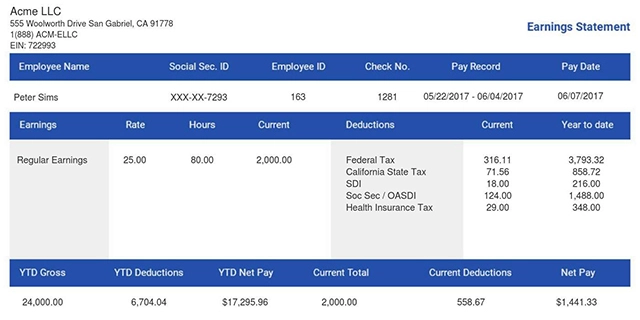
If you use ThePayStubs.com to generate pay stubs for your team, check the federal withholding line on each stub. It should match what each employee entered on their W4.
What's New on the 2026 W4 Form

The IRS released a new W4 form for 2026 with three key changes. Most online guides still reflect 2024 or 2025 rules. Review these updates before you learn how to fill out a W4 for this tax year.
- Child Tax Credit Raised to $2,200: Up from $2,000 in 2025. If you haven't filed a new W4 since last year, submit one now to lower your withholding.
- Deductions Worksheet Expanded to 15 Lines: The new W-4 form added lines for OBBBA deductions, including tips, overtime pay, and qualified vehicle loan interest.
- New Exempt Checkbox: This appears between Steps 4 and 5. It replaces the old method of writing "Exempt" by hand.
IRS note: The Tax Withholding Estimator has not been updated for the One Big Beautiful Bill Act provisions as of early 2026. Anyone with tip income, overtime, or vehicle loan interest should check their withholding by hand until the IRS updates the tool.
When Should You Fill Out a New W4?
Knowing how to fill out a W4 also means knowing when to file a new one. Fill out a new W4 when you start any job. Update it after life changes such as marriage, divorce, a new child, a second job, or a significant income shift. January is the best time, so changes apply to the full tax year. There is no limit on how often you can update it.
Outside of starting a new job, update your W4 if any of the following apply:
- Your income changed a lot (raise, pay cut, or new employer)
- You got married, divorced, or had or adopted a child
- A child turned 17 and aged out of the $2,200 qualifying child credit
- You started or stopped self-employment or a side job
- You received a large tax refund (over-withheld) or owed a big amount (under-withheld)
January is best. Changes early in the year affect withholding across all 12 months.
How To Adjust Your W4 To Get More or Less Tax Withheld

Part of how to fill out a W4 correctly is adjusting it when your tax situation changes. Submit a new W4 at any time. There is no waiting period.
- Too Much Withheld (Large Refund): You are lending money to the government. Lower withholding by adding credits in Step 3 or deductions in Step 4(b).
- Too Little Withheld (Owe Taxes in April): Lower your Step 3 credits or add extra withholding in Step 4(c). Even $15 to $25 extra per paycheck can clear a balance by year-end.
Use the IRS Tax Withholding Estimator to find the exact Step 4(c) amount you need. After filing a new W4, check the federal income tax line on your next pay stub. That confirms the change took effect.
W-2 vs. W4: What's the Difference?
New employees and small business owners often confuse these forms. Here is a quick comparison:
| W4 | W-2 | |
|---|---|---|
| When | At hire, and when your situation changes | Each year, by January 31 |
| Who fills it out | Employee | Employer |
| Purpose | Tells the employer how much to withhold from your paycheck | Reports what was withheld |
| Goes to | Your employer | IRS + employee |
The W4 is the input. The W-2 is the output. You set withholding on your W4 at the start of the year. You see the result when you get your W-2 in January.
Mistakes To Avoid When You Fill Out a W4
People who are learning how to fill out a W4 often make these four errors:
- Both Spouses Claiming All Dependents: When married filing jointly, only one W4 should list the children. If both do, each employer under-withholds, and you owe at filing.
- Skipping Step 2 With Two Jobs: Each employer withholds as if it were your only job. Without Step 2, both paychecks are under-withheld. The shortfall adds up fast.
- Not Updating After a Life Event: Marriage, divorce, a new child, or a job change all affect your tax liability. Each one calls for a new W4.
- Referencing the Old Allowances System: The W4 was redesigned in 2020. The "0 allowances" or "1 allowance" language no longer applies. If someone tells you to claim a number of allowances, they mean a form that no longer exists.
Using the IRS Tax Withholding Estimator
When you learn how to fill out a W4, the IRS Tax Withholding Estimator at irs.gov/individuals/tax-withholding-estimator is the best tool for Step 4(c).
Before you start, have ready:
- Your most recent pay stub for tax filing (shows year-to-date federal withholding)
- Last year's tax return (for income, deductions, and credits)
The tool tells you "Your withholding is on track" or gives a dollar amount for Step 4(c).
2026 Caveat: The estimator has not been updated for the "One Big Beautiful Bill Act" rules. Anyone with tip income, overtime, or vehicle loan interest should review withholding by hand until the IRS updates the tool.
You Might Also Like
- How Do You Get Your W-2 Online?
- How to Fill Out a 1099-MISC Form
- Is PTO Taxed? What Employers and Employees Need to Know
- Medicare Tax Explained
- How to Calculate Tax on 1099-MISC Income
Conclusion
Knowing how to fill out a W4 is one of the simplest ways to avoid a surprise tax bill or a large tax refund you did not need. For most employees, the form takes under ten minutes to complete. Once your employer processes your updated W4, check the Federal Income Tax (FIT) line on your next pay stub. That line shows exactly how much your employer withheld based on your W4 entries.
Use a professional pay stub generator to create accurate pay stubs that reflect your actual withholding. It works for self-employed workers, contractors, and small business owners managing payroll for their team.
- 1. Enter Your Information

- 2. Select Your Favorite Theme

- 3. Download Your Stub!


 By
By