

Accrued PTO Meaning: How to Read and Calculate It (2026)
 By
By
You're looking at your pay stub and there's a line that reads PTO Accrued: 43.20. Your manager said you had "about a week" saved up. Those two things don't obviously match, and now you're not sure how much time off you actually have.
The accrued PTO meaning is simpler than that number makes it look. It's paid time off you've already earned but haven't used yet, built up gradually as you work instead of handed to you all at once.
This guide covers the accrued PTO meaning, how employers calculate it, where to find the balance on your pay stub, what caps and rollover rules do to it, and what happens to unused time when you leave a job. If you're the one running payroll for a small team, the last section walks through setting up a policy your employees can actually follow.
Key Takeaways
- The accrued PTO meaning in one line: paid time off you've earned but haven't used yet, banked a little at a time as you work.
- The core formula is annual PTO hours divided by the number of pay periods in a year.
- Accrued minus used minus scheduled equals what you can actually request today.
- Whether unused PTO gets paid out when you leave depends on your state and your employer's written policy.
- Accrued PTO Meaning: The Plain Definition
- How Does Accrued PTO Work?
- How to Calculate Accrued PTO
- Accrued PTO Meaning on Your Pay Stub
- What Affects Your PTO Accrual Rate?
- Accrual Caps, Rollover, and Use-It-or-Lose-It Rules
- What Happens to Accrued PTO When You Leave a Job?
- Setting Up an Accrued PTO Policy for Your Business
Accrued PTO Meaning: The Plain Definition
Accrued PTO is paid time off you have already earned but have not used yet. Instead of receiving your full annual allotment on day one, you bank it gradually as you work, usually a set number of hours per pay period. The balance carries forward until you use it, hit a cap, or leave.
That's the accrued PTO meaning in one paragraph. The word "accrued" is what's doing the work in it.
You'll also see it called accrued time off, which means the same thing. Either way, accrued time isn't a promise your employer made for later in the year. It's compensation you've already worked for, and that's exactly why it can still have value after you're gone.
Most employers pick accrual over the alternative, which is front-loading. With front-loaded PTO, your whole year's allotment appears on January 1. It's easier to explain, but it creates an obvious problem: someone who takes all 15 days in February and resigns in March has spent time off they never earned.
Accrual fixes that. You earn as you go, so the balance always reflects work you've actually done.
Worth noting that the accrued PTO meaning shifts a little depending on which side of payroll you're sitting on. To an employee, it's time you can spend. To an employer, the identical figure is a liability on the books that grows every pay period until somebody finally takes a vacation.
How Does Accrued PTO Work?

Accrued PTO works on an earning schedule set by your employer. You accumulate time off per hour worked, per pay period, per month, or on your work anniversary. Many employers add a waiting period, often 30 to 90 days, before newly accrued time can actually be requested and taken.
Employers generally pick one of four accrual triggers:
- Per hour worked. Common for hourly and part-time staff, since the balance tracks the hours you actually log.
- Per pay period. The usual setup for salaried employees. A fixed amount lands every time payroll runs, so how often you're paid sets the size of each deposit.
- Monthly. A set number of hours on the same date each month.
- On your work anniversary. A lump amount that unlocks with each year of service.
Whichever trigger your employer picks, the accrued PTO meaning stays the same. Only the speed changes.
Two other rules decide when you can spend what you've banked. The first is that waiting period. You might be accruing from day one but still blocked from requesting time off until you clear 90 days on the job.
The second is the reset. Your accrual year restarts on a calendar year, a fiscal year, or your hire date, and that reset is what triggers the rollover and use-it-or-lose-it rules further down.
How to Calculate Accrued PTO
This is where the accrued PTO meaning turns into a number you can verify yourself. Every calculation starts from two figures: how much PTO you get in a year, and how many times the clock ticks in that year.
Annual PTO hours ÷ periods per year = PTO earned per period
Say your employer offers 15 days. Payroll runs in hours, so convert first: 15 days × 8 hours = 120 hours per year. Here's what those 120 hours look like on every common schedule.
| Pay schedule | Periods per year | PTO earned per period |
|---|---|---|
| Weekly | 52 | 2.31 hours |
| Biweekly | 26 | 4.62 hours |
| Semi-monthly | 24 | 5.00 hours |
| Monthly | 12 | 10.00 hours |
| Per hour worked | 2,080 hours | 0.0577 hours |
That last row catches people out. Hourly employees usually accrue per hour worked rather than per paycheck, using 2,080 hours as the full-time year (52 weeks × 40 hours). Divide 120 by 2,080 and you earn 0.0577 hours of PTO for every hour on the clock. Worth knowing that 2,080 is a scheduling convention rather than a legal standard, so confirm the base your employer actually uses if your full-time week isn't 40 hours.
Part-Time Proration
Working 20 hours per week instead of 40 doesn't change your accrual rate, it changes the hours you apply it to. At that same 0.0577 rate, you'd finish the year with roughly half the PTO of a full-time coworker. The rate stays put; the hours worked do the work.
Converting Hours Back to Days
Balances are almost always shown in hours, which is why "43.20" doesn't read like a week off. Divide by your standard workday to translate it: 43.2 ÷ 8 = 5.4 days.
To project forward, multiply your per-period rate by the periods left. At 4.62 hours biweekly, another twelve pay periods adds 55.4 hours, or just under seven workdays.
Accrued PTO Meaning on Your Pay Stub

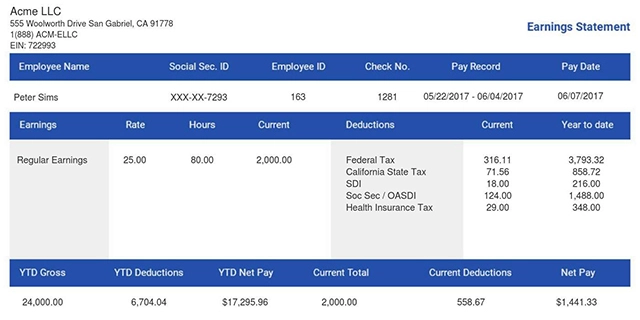
Your balance usually sits in a small block near the bottom of your pay stub, separate from earnings and deductions. Labels vary by payroll provider, but you'll typically see some version of these:
- PTO Accrued or PTO Earned: hours added this pay period
- PTO Used or PTO Taken: hours you've spent
- PTO Balance or PTO Available: what's left
- YTD columns: the same figures totalled since your accrual year began
If the rest of the shorthand on your stub looks like alphabet soup, our guide to pay stub abbreviations decodes it.
Here's the formula that reconciles everything:
Accrued − Used − Scheduled = Available
Suppose you've accrued 80 hours, used 20, and already have 10 hours approved for next month. You have 50 hours available, not the 60 your stub shows as a balance. That gap is the most common reason a pay stub and an HR portal disagree. The stub often reports what you've banked, while the portal nets out time that's approved but not yet taken.
One thing worth knowing if you're pulling paperwork together: an accrued balance isn't income yet. It won't show in your gross pay and a lender won't count it. It becomes income only when it's paid out, at which point it appears as an earnings line like anything else.
If your employer's stubs don't break PTO out clearly, you can keep a cleaner record with our pay stub templates.
What Affects Your PTO Accrual Rate?
Four factors drive your PTO accrual rate: how long you have worked there, whether you are full-time or part-time, whether you are still in a probationary period, and your employer's overall policy. Tenure is usually the biggest lever, with accrual rates stepping up at set service milestones.
Tenure tiers are close to universal, and the Bureau of Labor Statistics puts real numbers on the pattern. As of March 2025, private industry workers averaged 11 paid vacation days after one year of service, 15 days after five years, 18 days after ten, and 20 days after twenty. Your employer's milestones will differ, but that shape rarely does.
Employment status is the next lever. Full-time equivalent status is what most policies key on, and part-timers typically accrue proportionally rather than being excluded outright.
Probationary periods affect timing rather than rate. You accrue during those first 30 to 90 days under most policies. You just can't spend it yet.
Employer size matters more than most people expect. In March 2025 federal benefits data, 91% of private industry workers at companies with 500 or more employees had access to paid vacation, against 71% at companies with fewer than 50. The full-time split is starker still: 93% of full-time private industry workers had access, compared with 40% of part-time workers.
Accrual Caps, Rollover, and Use-It-or-Lose-It Rules
Caps don't change the accrued PTO meaning. They change how much of it you're allowed to hold at once, and two different limits both get called "the cap."
An annual accrual cap limits how much you can earn in one year. Once you've accrued your 120 hours, you stop earning more until the year resets, no matter how much longer you work.
A balance cap limits how much you can hold at any one moment. Hit a 240-hour ceiling and accrual simply pauses. It restarts as soon as you take time off and drop back under the limit. Balance caps commonly sit somewhere between 1.5 and 2 times the annual accrual amount.
Plenty of employers run both at once. A policy might let you earn 60 hours a year, roll over up to 40 into the next year, and hold no more than 90 hours in total.
One wrinkle if your employer folds sick leave into a single PTO bucket: states that mandate paid sick time set their own accrual floors, and combining the two can pull your whole balance under those rules.
Rollover rules decide what survives the reset. Full carryover moves everything forward, capped carryover moves a fixed maximum, and use-it-or-lose-it wipes whatever's left.
Use-it-or-lose-it is the harshest of the three, and some states restrict it outright. California treats earned vacation as wages that vest as you work, so forfeiting it is illegal there, though employers may still cap how much you accrue. Illinois takes a middle path: use-it-or-lose-it is permitted during employment, but earned vacation still has to be paid out when you leave. Check your own state before assuming a balance will simply vanish.
A quick warning about the other direction. Some employers approve time you haven't accrued yet, which puts you underwater. A negative PTO balance usually gets deducted from your final paycheck if you leave before working it off.
What Happens to Accrued PTO When You Leave a Job?
It depends on your state and your employer's written policy. No federal law requires employers to pay out unused PTO when you leave. Several states do treat accrued vacation as earned wages that must be paid on separation, while in the rest, your employer's policy decides.
This is the point where the accrued PTO meaning carries actual money, so it's worth knowing which side of the line you're on before you resign. The Fair Labor Standards Act doesn't require payment for time not worked, so vacation and PTO are treated as matters of agreement between you and your employer, with state law layered on top.
States that do require payout of earned, unused vacation include California, Colorado, Illinois, Massachusetts, and Maine, though Maine's rule covers only private employers with 11 or more employees. That list isn't exhaustive and these rules do get amended, so confirm your own state's 2026 position rather than assuming. In states treating accrued vacation as earned wages, an employer can cap how much you accrue but can't make you forfeit what you've already banked. Elsewhere, a written forfeiture policy is generally enforceable, which is precisely why the employee handbook matters.
When a payout does happen, it lands on your final pay stub as a separate earnings line and it's taxable, so expect withholding to come off the top. Our guide on whether PTO payouts are taxed covers how that works.
Before your last day, screenshot your balance and keep your final stubs. If a payout comes up short, that record is your evidence, and state pay stub laws determine what your employer has to give you in writing.
Setting Up an Accrued PTO Policy for Your Business
Employees rarely ask about the accrued PTO meaning until they want to book a week off, and by then your policy needs to have an answer. Running a small business without an HR system means four decisions land on you, and none of them require software.
- Pick an accrual method. Per pay period is simplest to administer for salaried staff. Per hour worked is fairer if your team's hours swing week to week.
- Set the rate. Convert your intended annual allotment into hours, then divide by your pay periods. Ten to fifteen days per year is a common starting point for small employers.
- Decide caps and rollover. Choose whether unused time carries over, and cap the balance so the liability doesn't quietly compound.
- Write down what happens at separation. Your state may decide this for you. Where it doesn't, silence in the handbook tends to get read against the employer.
Then do the part small employers skip: show the balance on every pay stub. Someone who can see accrued, used, and available hours each payday stops asking, and you get a running record if a dispute ever comes up. That record does double duty when staff need proof of income documents for a lease or a loan.
You Might Also Like
- What Is Unlimited PTO?
- Unpaid PTO: How It Works
- Free PTO Policy Template
- Does PTO Count Towards Overtime?
- How Many Sick Days a Year Is Normal?
Conclusion
The accrued PTO meaning comes down to this: it's time off you've already earned, banked at a rate your employer sets, and displayed on your pay stub as a running balance. Once you can convert hours into days and subtract what you've already scheduled, the number stops being mysterious. What happens to that balance when you leave depends on two things, your state's rules and what your employer put in writing.
Checking your own balance or documenting pay for a team both come down to accurate records. Create clean, professional ones in minutes with our pay stub generator.
- 1. Enter Your Information

- 2. Select Your Favorite Theme

- 3. Download Your Stub!

 By
By