

Google Pay Stub Guide: Access & Understand Yours (2026)
 By
By
Alphabet Inc. runs payroll for more than 180,000 employees through Workday HCM. If you work there, your google pay stub isn't in Google Docs or your personal Drive. It's in Workday. Many searches lead to template galleries for Google Sheets and Docs, useful for freelancers and contractors who need a paystub generator. This guide is for a different need entirely.
You'll find a plain-English breakdown of your pay stub contents and step-by-step Workday access instructions. You'll also learn what Google-specific deductions mean and what to do after leaving Alphabet. Need pay stubs for a mortgage, rental application, or proof of income? There's a section for that too.
Key Takeaways
- Google employees access pay stubs through the Workday HCM portal at workday.com using Google Workspace credentials
- Your pay stub shows gross earnings, all tax withholdings, and benefit deductions for each pay period
- FICA taxes are 6.2% for Social Security (capped at $176,100 in 2026) and 1.45% for Medicare on all wages
- Alphabet's pay stubs include Google-specific items: RSU supplemental withholding, 401(k) matching, and commuter benefits
- Former Googlers should download all pay stubs before departure since Workday access is deactivated after leaving
What Is a Google Pay Stub?
A google pay stub is a document Alphabet Inc. issues to each employee each pay period, showing gross earnings, withholding details, and benefit deductions. The pay stubs for Google employees are in Workday HCM at workday.com, employees sign in with their Google Workspace credentials, the same login used for Gmail and Drive. This is different from Sheets or Docs stored in Google Drive, which is typically used by freelance workers creating stub templates for clients.
Many of those searches are looking for payslip templates built inside Google Docs or Google Sheets. Those work well for contractors and self-employed workers who create their own earnings statements. For Googlers on Alphabet's payroll, your pay stub comes from Workday, not from Drive.
In most states, employers are required to provide an itemized wage statement listing each compensation item, each deduction, and the employer's name and address. More than 40 states have specific itemization requirements. Workday's itemized pay stubs meet all of these requirements. They're also your primary evidence in any wage dispute and useful for verifying payroll records during employment checks.
What's on a Google Pay Stub?
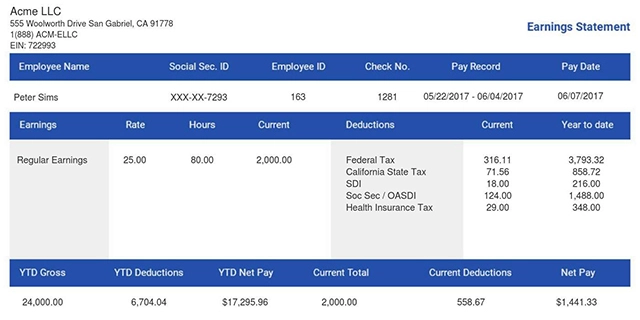
A Google pay stub shows your gross pay (total earnings before deductions), itemized withholdings including federal and state income tax, Social Security at 6.2%, and Medicare at 1.45%, plus benefit deductions like 401(k) contributions and health insurance premiums. Net pay is your take-home amount. Year-to-date totals appear alongside every line item.
When first reviewing a pay stub, it helps to understand its main sections. Every Workday pay stub is organized the same way across all pay periods.
Earnings and Gross Pay
Your total compensation for the pay period, before any deductions, is called gross pay. For salaried employees, that's your annual base salary divided by 26 biweekly periods. Your earnings section also shows:
- Regular hours: The standard calculation for a biweekly pay period based on your employment agreement
- Overtime earnings: Calculated at 1.5x your regular rate when applicable
- Supplemental wages: Bonuses, commissions, or RSU (restricted stock unit) vesting proceeds that fall within the pay period
Verify that the pay period dates shown on the stub match the Earned Dates listed in Workday exactly. Your employee ID and employer information appear in the header section alongside those dates.
Taxes and FICA Deductions
Tax withholding covers the largest portion of deductions on most pay stubs. Here's what each line means:
- Federal income tax: Calculated based on your W-4 elections and income bracket. Senior-level Google employees may see 32% or 37% marginal rates on regular wages.
- State income tax: Varies by work location. California tops out at 13.3%. Washington state has no state income tax.
- Social Security: 6.2% of the first $176,100 in earnings for the calendar year. Once you hit that threshold, Social Security withholding stops for the rest of the year.
- Medicare: 1.45% on all wages, with an Additional Medicare Tax of 0.9% once earnings exceed $200,000. This only applies to the employee portion, so your employer's matching Medicare contribution doesn't appear on your pay stub.
FICA is Social Security plus Medicare combined. Your employer matches both, but that match doesn't show on your personal stub.
Net Pay and Year-to-Date Totals
The number most people care about is what actually lands in their bank account: that's your take-home pay, calculated as gross earnings minus every deduction. Year-to-date totals sit next to each line item and track cumulative amounts since January 1. These matter at tax time when you're reconciling your W-2. They're also helpful when a lender or landlord asks for total income earned over a specific period.
Most Googlers receive pay via direct deposit on a biweekly schedule. The earnings statement in Workday reflects the exact deposit amount that'll hit your bank account. Comparing YTD figures against prior pay stubs is the fastest way to spot where a payroll error occurred.
How to Access Your Google Pay Stub Via Workday
Your pay stubs are generated online through Workday HCM. Alphabet processes all payroll through this platform, and current pay stubs are available online as soon as they are posted. Follow the steps below to view your pay stubs in Workday HCM.
Here's how to get google paystub step by step:
- Go to workday.com (or the Alphabet-specific Workday URL your IT team provided)
- Enter your Google Workspace email and password to sign in to Workday
- From the Workday home screen, locate the Pay worklet (it appears alongside other worklets on the main dashboard)
- Under Payslips, your pay history appears listed by pay period date
- Click the period you want, then select View/Print to read it online or Download to save as a PDF
Your pay stub is available in Workday the same day your paycheck posts. If you can't find the Pay worklet, use the Workday search bar and type "payslips." If your login credentials fail, contact Google IT support through your standard help desk channel to reset access.
Workday mobile: Workday offers a free app for iOS and Android. Sign in with your Google Workspace credentials and navigate to Pay, then Payslips. You'll see the same data as the desktop version.
Proactive saving: Download and save your pay stub PDFs somewhere outside your work Google account after each pay period. Google runs payroll on a biweekly schedule, so you'll have a new stub available roughly every two weeks. Once you leave Alphabet, your Workday account is removed and historical pay stubs become inaccessible through the portal.
A downloadable PDF of your entire google pay stub includes your full legal name, pay period dates, Alphabet's employer ID, and your department. It also shows the direct deposit amount. These fields matter when a lender asks for proof of payroll source during mortgage underwriting.
Google Employee Paystub: Key Deductions Explained

As a Google employee, your pay stubs will have more lines of deductions and withholdings than a typical employer. Alphabet's total compensation package is unusually comprehensive, which means more entries than a standard paycheck.
Tax Withholding on Supplemental Income
As RSUs vest, they are treated as supplemental wages subject to supplemental withholding by Alphabet. The supplemental federal withholding rate is 22% on supplemental wages, or 37% if the total paid to an individual in a calendar year exceeds $1 million. Workday reports this supplemental withholding separately from regular compensation withholding on payslips.
Employees approaching the $200,000 earnings threshold should watch their year-to-date figures. Additional Medicare Tax at 0.9% applies automatically once wages cross that level. Workday's payroll engine tracks cumulative earnings and adjusts tax withholding mid-year as needed.
Google-Specific Benefit Deductions
In addition to tax withholdings, your Alphabet pay stub includes several employer-specific deduction items:
- 401(k) contribution: Your elected deferral amount (up to the IRS annual limit of $23,500 in 2026). Google's employer match appears as a separate employer contributions line on the same stub.
- Health insurance premiums: Pre-tax medical deductions based on your plan selection. Dental and vision premiums appear as separate benefit deductions line items.
- Commuter benefits: Pre-tax transit or parking deductions. Common for employees in San Francisco, New York City, or Kirkland, Washington.
- Voluntary deductions: Supplemental life insurance, FSA contributions, or other items you enrolled in during open enrollment.
Keep in mind that these additional deductions reduce your taxable gross income. That's why your federal income tax withholding is lower than what your bracket rate would suggest.
Former Google Employees: Accessing Old Pay Stubs
When you leave Alphabet, your Workday account will typically be deactivated within 30 to 90 days after your last day. After deactivation, you'll no longer be able to log into the Workday portal to access your pay history.
Before your last day: Download every pay stub you want to keep and save to personal cloud storage, not your @google.com Drive. Pull recent W-2 forms too, or confirm your mailing address is current in Workday so Alphabet can mail them to you.
After deactivation: Contact Google People Operations (HR) to request copies of historical earnings statements. Build in lead time if you need records for a specific purpose like a mortgage application or legal matter. State labor laws typically require employers to keep payroll records for at least three years. HR should be able to locate your stubs even years after you left.
W-2 forms: These don't require Workday access. Alphabet mails W-2s to the address on file by January 31 each year, even for former employees. Update your address before your last day.
Can't access your old records? Employment verification and proof of income documents outlines what former employers are legally required to provide.
Google Paystub Generator: Create Proof of Income Online
Many Google employees live in San Francisco, New York City, or Seattle, three of the most competitive rental markets in the country. Landlords in those cities routinely ask for two to three months of pay stubs as proof of income before approving a lease. Mortgage lenders require the same documentation alongside W-2s and bank statements.
Your income statements are in your Workday account, under Pay in the HCM portal. PDF versions of your earnings statements clearly state your employer, income, and gross earnings for the period. They can be uploaded directly to the websites of your lender or landlord.
If you can no longer access your Workday account, you can generate a google pay stub online in minutes by entering your wage details. Search for "google pay stub online" and you'll find template options in Google Docs and Sheets. An online generator is faster and produces a more consistent, lender-ready format.
Need proof of income for an apartment or loan application? A pay stub generator creates professional documentation in minutes.
You Might Also Like
- AT&T Paystub: How to Access & Download Your Pay Stub (2026)
- How To Access Verizon Paystub: An Overview for Former and Current Employees
- Microsoft Paystub: How to Access & Download Yours (2026)
- Proof of Income Documents: 6 Instances You'll Need a Pay Stub
- Self-Employed? Here's How to Show Proof of Income
Conclusion
Your google pay stub is more than a receipt for your paycheck. Lenders want it for mortgage applications. Landlords require it before approving a lease. It's also your main record for confirming payroll taxes were withheld correctly throughout the year. Now with a different employer? Learn how to get a pay stub from any employer.
Log into Workday at workday.com to pull your pay stubs anytime. Download PDFs and save them outside your work account. Left Alphabet and can't access Workday? A pay stub generator creates accurate, professional pay stubs in minutes.
- 1. Enter Your Information

- 2. Select Your Favorite Theme

- 3. Download Your Stub!

 By
By