

Proof of No Income for Medicaid: What to Submit in 2026
 By
James Wilson
By
James Wilson When you have little or no income and need Medicaid coverage, knowing what to submit can feel overwhelming. The good news is proof of no income for Medicaid follows a clear process, but it does require actual paperwork. You can't simply tell your caseworker you have no income and expect approval. For the full documentation picture, start with our complete proof of income guide.
Gathering the right proof of no income for Medicaid starts with knowing your documentation options. Use a pay stub generator to document your earnings history quickly, and this guide covers the rest: accepted documents, zero income attestation, and what 2026 income limits apply to your program.
Key Takeaways
- Proof of no income for Medicaid requires written documentation. A verbal claim won't qualify your application.
- Most states provide a zero income self-attestation form you can sign and submit alongside your application.
- Pay stubs are among the most widely accepted income documents, even for workers with minimal or zero earnings.
- 2026 Medicaid long-term care income limit is $2,982 per month for a single applicant in most states.
- Medicaid automatically cross-checks your income against Social Security Administration and IRS records.
What Is Proof of No Income for Medicaid?
Proof of no income for Medicaid is written documentation showing you have no current earnings or income below the eligibility threshold. Most states accept a zero income self-attestation form, a signed statement declaring your income status, supported by a recent bank statement or termination letter. This documentation is required for all Medicaid applicants with no earned income.
Common situations that require zero income proof include recent job loss, self-employment with no active projects, gaps between gig assignments, and retirement without pension income. Zero income proof applies when your earned income is literally $0, not just income below the federal poverty level. Those are two different scenarios with different documentation requirements.
States use your submitted documentation alongside automated income verification systems to make eligibility decisions. Having your proof of income documents ready before you apply speeds up the process. If your stated income doesn't match government databases, you'll be asked for additional proof before your application moves forward.
Does Medicaid Require Proof of Income?

Yes. Medicaid requires written proof of income in all 50 states. The burden of proof falls on the applicant. Medicaid can't approve your application based solely on a verbal statement. Most states also cross-check your reported income against IRS and Social Security Administration records before making an eligibility decision.
This matters because Medicaid doesn't simply take your word for it. Federal rules require income verification documents at three points: initial application, annual redetermination, and whenever income changes. The burden of proof is on you, not the state.
Does Medicaid ask for proof of income even for small amounts? Yes. There's no minimum threshold below which documentation is waived. A worker who earned $5 last month still needs to document that amount. Someone with genuinely $0 income still needs a signed attestation form.
Every state uses the same basic standard: documented evidence, not self-reported estimates. Proof of income for Medicaid must show actual figures, whether that number is $2,000 per month or $0.
What Documents Count as Proof of Income for Medicaid
Medicaid accepts a range of income documents, and the right type depends on your specific situation. If you have income, standard proof of income for Medicaid documents are usually enough. If you have no income, those same documents apply, with a zero income attestation form added to the package. Here's what qualifies and what Medicaid looks for in each document.
Documents Accepted as Proof of Income
- Pay stubs: Must show gross earnings, employer name, pay period dates, and year-to-date totals. Most states require stubs from the past 30 to 90 days.
- Social Security award letter: Your benefit verification letter from the Social Security Administration confirms your monthly gross benefit amount. This is the standard document for proof of income for Social Security recipients applying for Medicaid.
- SSI, Railroad Retirement, or VA benefit letters: Government letters showing your gross monthly payment from any federal benefits program.
- Pension statements or employer letters: Must come on official letterhead and show the gross payment amount.
- Income tax return: Especially Schedule C for self-employed applicants. Medicaid typically accepts the prior year's federal return.
- Dividend, alimony, or rental income statements: Must come from an official source with a verifiable dollar amount.
Criteria for Acceptance
Documents must be recent. Most states require income documents from the current year or the past 30 to 90 days depending on the program. Always provide the gross amount, not the take-home amount, since Medicaid eligibility is calculated on pre-tax income.
Documents must also come from an official source: employer letterhead, a government agency, or a financial institution. A handwritten note from an employer won't qualify. If you're a 1099 contractor or self-employed, you'll need to show proof of income using a Schedule C from your most recent tax return. Some states also accept a signed income statement from a licensed CPA.
How to Submit Proof of No Income for Medicaid

Gathering proof of no income for Medicaid requires more than a verbal statement. The primary documentation method is a zero income self-attestation form. Most states provide a downloadable form through their Medicaid agency website. It may be called a "No Income Self Attestation" or "Declaration of No Income."
The form covers your name, Social Security number, and the dates you're claiming no income. You'll also include a declaration that you received no wages or benefits, then sign. Some states require notarization. Our proof of no income letter for medical guide includes a sample statement you can follow.
Supporting documents that strengthen a zero income claim include:
- A recent bank statement showing no income deposits for the past 30 to 90 days
- A termination or layoff letter from your most recent employer
- Written confirmation that no unemployment benefits were claimed
- A Schedule C showing $0 net income for self-employed applicants
Don't assume that telling your caseworker you have no income is enough. A verbal claim doesn't satisfy the documentation requirement in any state. The zero income attestation form is the formal mechanism for proof of no income for Medicaid applications, and it's not optional. SNAP follows similar rules, as our proof of income for food stamps guide explains.
Gig workers and self-employed people face an extra layer of complexity here. If you've had any gig platform activity in the past 12 months, Medicaid may cross-check that against IRS 1099-K records. Earnings of $600 or more from gig platforms like DoorDash or Etsy in the prior year may appear in IRS records. That holds true even if your current earnings are $0. Be prepared to document the difference.
Showing a documented pay history strengthens a zero income claim. Generating accurate 1099 pay stubs or standard earnings records gives you a clear income record for any period you need to cover.
Medicaid Income Limits in 2026
Medicaid income thresholds vary by program and state. Here's what the 2026 limits look like across the most common categories:
- ACA expansion states: 138% of the federal poverty level, roughly $20,783 per year ($1,732 per month) for a single adult. Most states that expanded Medicaid under the ACA cover any adult under this threshold.
- Long-term care and nursing home Medicaid: $2,982 per month for a single applicant in 2026 in most states. This applies to seniors and people with disabilities seeking institutional or home-based long-term care services.
- Non-expansion states (9 states as of 2026): Adults without dependent children in these states often don't qualify for standard Medicaid regardless of income. Emergency Medicaid may be the only option.
- California Medi-Cal: California covers adults up to 138% FPL through Medi-Cal. For proof of income for Covered California marketplace plans, residents above that threshold use Covered California's income verification process instead.
Medicaid income is calculated using MAGI, or Modified Adjusted Gross Income, which mirrors IRS calculation methods. Your gross monthly income — including wages, tips, self-employment income, unemployment benefits, and taxable Social Security income — is what Medicaid evaluates. Non-taxable Social Security income is excluded from MAGI calculations, which matters for some senior applicants.
The proposed 2026 HHS income documentation rule changes remain blocked by federal courts as of June 2026. Current standards are unchanged. The proof of no income for Medicaid process in this guide reflects active requirements.
How Medicaid Verifies Your Income
Medicaid doesn't rely solely on the documents you submit. States use automated systems to cross-check what you report against federal and state records. The primary system is IEVS (Income Eligibility Verification System). It connects Medicaid to SSA, IRS, and state wage databases at the same time.
In practice, if you claim zero income but IRS records show a 1099 from last year, Medicaid will flag the discrepancy. You'll need to provide an explanation before your application can be approved. You won't be automatically denied, but you do need to document why your income is now $0.
Misreporting income on a Medicaid application, even unintentionally, has real consequences. You may owe back benefits, face a period of ineligibility, or in serious cases be referred for fraud prosecution. Accurate, documented income claims protect your eligibility status. For full eligibility rules, Medicaid.gov publishes current program requirements by state.
Using Pay Stubs as Proof of Income for Medicaid
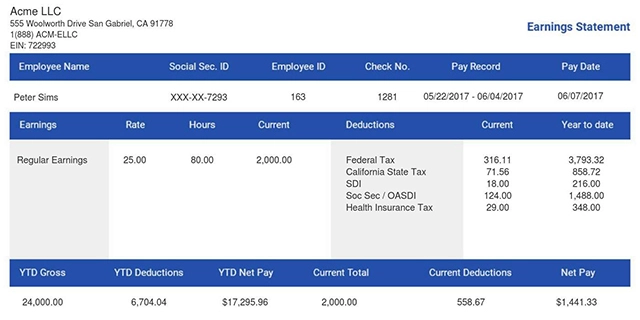
Pay stubs are the gold standard income document accepted by Medicaid in all 50 states. A Medicaid-ready pay stub shows your name, employer name, pay period dates, gross earnings, year-to-date totals, and deductions.
Self-employed workers and contractors can generate pay stubs showing current earnings. That includes periods where the amount is minimal or $0. A documented pay stub trail also helps during annual Medicaid redetermination, since you'll have dated records showing your income history.
For individuals and small business owners, having professional pay stubs on file simplifies income verification significantly. See also our guide on proof of income if paid in cash for documentation strategies that apply to variable-income earners and contractors.
You Might Also Like
- Pay Stubs for Loan Applications
- How to Write a Proof of Income Letter
- What Is Annual Income
- How to Calculate W-2 Wages From a Pay Stub
- W-2 vs 1099: How to File Taxes When You Have Both
Conclusion
Medicaid requires documented proof of income, or documented proof of no income, from every applicant. A signed zero income self-attestation form supported by a recent bank statement or termination letter is the standard way to document a $0 income status. Having your proof of no income for Medicaid paperwork organized before you apply makes the process faster. Bring pay stubs for any period where you did have earnings to minimize the risk of delays.
Need professional income documentation for your Medicaid application? Use our pay stub generator to create accurate, state-accepted pay stubs in under two minutes.
- 1. Enter Your Information

- 2. Select Your Favorite Theme

- 3. Download Your Stub!

 By
By