Payments Exempt From FUTA Tax: 2026 Employer Guide
 By
FUTA costs most employers $42 per worker each year. That number assumes every dollar you pay counts as wages. It doesn't. Some payments exempt from FUTA tax never touch the $7,000 wage base, and leaving them in means you overpay or file Form 940 wrong.
This guide is for small business owners who run their own payroll. It also helps workers who want to read their pay stubs with confidence. You'll get the full IRS list of exempt payments, the 2026 changes, and who skips the tax entirely. You'll also see a worked example and the Form 940 lines where it all gets reported.
Key Takeaways
- FUTA is 6% on the first $7,000 of each worker's pay, or 0.6% after the full state credit.
- Health coverage, group-term life, employer retirement contributions, and dependent care are not FUTA wages.
- In 2026, the dependent care limit rises to $7,500, and moving pay is taxable for most workers.
- Employees never pay FUTA. It should not show up as a deduction on a pay stub.
- What Is FUTA Tax?
- What Payments Are Exempt From FUTA Tax?
- Payments Exempt From FUTA Tax vs. Taxable Payments
- 2026 Changes to Payments Exempt From FUTA Tax
- Who Is Exempt From FUTA Tax?
- FUTA Tax Rate 2026 and the FUTA Wage Base
- How to Calculate FUTA Tax With Exempt Payments
- Reporting Payments Exempt From FUTA Tax on Form 940
- What Is FUTA and SUTA Tax?
- What Is FUTA Tax on My Paycheck?
- Conclusion: Tracking Payments Exempt From FUTA Tax
What Is FUTA Tax?
FUTA tax is a federal payroll tax that employers pay under the Federal Unemployment Tax Act to fund unemployment benefits. The rate is 6% on the first $7,000 each employee earns per year. Most employers get a 5.4% credit for paying state unemployment tax, so they owe 0.6%, or $42 per worker.
Congress passed the Federal Unemployment Tax Act in 1939. The money pays for the federal side of unemployment insurance. That covers program costs, extended benefits, and loans to states that run short. Your state runs its own fund, and you pay into that one separately.
People often type "who is FUTA" or just "FUTA?" into a search bar after spotting the term on a report. It isn't a person or an agency. It's the name of the law, and the IRS collects the tax.
A few basics make the rest of this guide easier:
- Employer only. As a futa payroll tax, it comes out of business funds, unlike income tax. You never withhold it from a paycheck.
- Annual cap. Only the first $7,000 per worker per year is taxed.
- Filed yearly. You report it on Form 940 once a year, but you may deposit it each quarter.
What Payments Are Exempt From FUTA Tax?

Five groups of pay are exempt, and they match Form 940, line 4: fringe benefits like health coverage and cafeteria plans, group-term life insurance, employer retirement contributions, dependent care assistance, and other payments such as workers' compensation, family employment, and certain farm wages. You subtract them before applying the $7,000 wage base.
The IRS lists these in the Instructions for Form 940. Each group has its own checkbox on line 4. Here's what falls under each one.
Fringe Benefits (Box 4a)
This box covers benefits the tax code already excludes from pay:
- The value of certain meals and lodging you provide for your convenience
- Employer contributions to accident or health plans (see how employer-sponsored health insurance shows on a W-2)
- Certain employer payments to a health savings account or Archer MSA
- Benefits paid through a section 125 cafeteria plan
So if you cover $400 a month of a worker's health premium, that $4,800 a year is FUTA exempt.
Group-Term Life Insurance (Box 4b)
The cost of group-term life coverage you provide is not FUTA wages. This applies even above the $50,000 coverage level that triggers income tax on the employee.
Retirement and Pension Contributions (Box 4c)
Your contributions to a qualified plan are exempt. That includes a 401(k) match and a SIMPLE IRA employer contribution. There's a catch here. The money an employee chooses to defer from their own pay is still taxable for FUTA.
Dependent Care (Box 4d)
Dependent care assistance is exempt up to the amount the employee can exclude from income. For 2025, that's $5,000, or $2,500 for a married person filing separately. The care must allow the employee to work.
Other Exempt Payments (Box 4e)
Anything that doesn't fit boxes 4a to 4d lands here. The most common ones:
- Workers' compensation for a work-related injury or sickness
- All non-cash pay and some cash pay for farm labor, plus all pay to H-2A visa workers
- Domestic service pay if you stayed under $1,000 in cash wages each quarter
- Pay to your parent, spouse, or child under 21
- Pay for certain fishing work
- Pay to certain statutory employees
- Pay to nonemployees your state treats as employees
The family rule has limits, so don't assume all pay to relatives belongs on your list of payments exempt from FUTA tax. It applies when you run a sole proprietorship. A child who works for your corporation is a regular employee.
Payments Exempt From FUTA Tax vs. Taxable Payments
Some payments look like benefits but still count as futa taxable wages. Getting these wrong is the most common way employers underpay.
| Payment | FUTA Treatment |
|---|---|
| Employer 401(k) match | Exempt (Box 4c) |
| Employee 401(k) or SIMPLE deferrals | Taxable |
| Employer health premiums | Exempt (Box 4a) |
| Moving expense reimbursement | Taxable (except some military moves) |
| Bicycle commuting reimbursement | Taxable |
| Bonuses and commissions | Taxable |
| Vacation and holiday pay | Taxable |
| Tips reported to you | Taxable |
A good rule: if it shows up in box 1 of the W-2 as regular pay, it's usually FUTA wages too. Employee deferrals are the big exception. They leave box 1 but still count for FUTA.
2026 Changes to Payments Exempt From FUTA Tax

The One Big Beautiful Bill Act changed two items on the exempt list. Both show up in the 2026 Publication 15-B, the IRS guide to fringe benefits.
| Item | 2025 | 2026 |
|---|---|---|
| Dependent care limit | $5,000 ($2,500 MFS) | $7,500 ($3,750 MFS) |
| Moving expense pay | Taxable (temporary rule) | Taxable for good, except armed forces and intelligence moves |
The higher dependent care limit means more of that benefit stays exempt starting with 2026 pay. Your 2025 return still uses the $5,000 limit. Moving and bike commuting pay were taxable from 2018 through 2025 under a temporary rule. The new law makes that permanent.
Who Is Exempt From FUTA Tax?
You're exempt from FUTA tax if you never paid $1,500 in wages in a calendar quarter and never had an employee in 20 different weeks. Household employers owe it only after $1,000 in quarterly cash wages, farms after $20,000. Most 501(c)(3) nonprofits and government employers don't pay it at all.
Payments exempt from FUTA tax and exempt employers are two different ideas. The section above covers payments. This one covers who pays FUTA in the first place.
Which Test Applies to You
The IRS uses three tests to decide if you must pay:
- General test. You paid $1,500 or more in wages in any calendar quarter, or you had at least one employee for part of a day in 20 or more different weeks. This looks at the current or prior calendar year.
- Household test. You paid $1,000 or more in cash wages to household workers like a nanny in any quarter.
- Farm test. You paid $20,000 or more in cash wages to farmworkers in a quarter, or had 10 or more farmworkers in 20 different weeks.
Meet any test that applies to you, and the tax applies.
Employers With a FUTA Tax Exemption
These federal unemployment tax exemptions cover whole organizations:
- 501(c)(3) charities, churches, and schools
- State and local governments
- Self-employed people with no staff
Partners in a partnership aren't employees, so their share of profits isn't FUTA wages. Independent contractors fall outside FUTA too.
So who is exempt from FUTA and SUTA? The answer depends on your state. A nonprofit that skips FUTA often still owes state tax or pays back state claims instead.
FUTA Tax Rate 2026 and the FUTA Wage Base
For 2026, the rate is still 6% on the first $7,000 of each worker's wages. Congress hasn't changed the futa wage base since 1983.
The futa tax credit brings most employers down to 0.6%. You earn up to 5.4% in credit when you pay your state unemployment tax on time and in full.
| Situation | Net Rate | Max Per Worker |
|---|---|---|
| No state credit | 6.0% | $420 |
| Full 5.4% credit | 0.6% | $42 |
| California (2025) | 1.8% | $126 |
Credit reduction hits states that owe the federal fund money. For 2025, California lost 1.2% of its credit. The U.S. Virgin Islands lost 4.5%. The Department of Labor names the states for each year in November. If you're checking the futa tax rate 2025 for last year's return, the base rate and wage base were the same.
How to Calculate FUTA Tax With Exempt Payments
Here's a worked example. Say you run a small bakery with two employees in a state with no credit reduction.
- Add up total pay. Maria earned $30,000. Jake, a part-timer, earned $6,500.
- Subtract exempt payments. You paid $3,600 toward Maria's health coverage. Jake had $500 of employer 401(k) match.
- Apply the $7,000 cap. Maria still has $26,400 left, so only $7,000 counts. Jake has $6,000, so all of it counts.
- Multiply by the rate. $13,000 times 0.6% equals $78.
Without the exemptions, Jake's taxable wages would be $6,500. That's $3 more in tax. It's small for one worker, but it adds up across a team. It also changes the numbers on your return.
The same math works for any size business. Payments exempt from FUTA tax come out first. Then you cap each worker at $7,000.
Reporting Payments Exempt From FUTA Tax on Form 940
The futa tax form is Form 940. Its full name is the Employer's Annual Federal Unemployment Tax Return. Employers must file it if they meet any of the three tests above.
Here's where exempt pay lands:
- Line 3: total payments to all employees
- Line 4: payments exempt from FUTA tax, with boxes 4a to 4e checked
- Line 5: pay above the $7,000 wage base for each worker
Only list a payment on line 4 if you included it on line 3. That rule trips up a lot of first-time filers.
When Is FUTA Tax Due?
The return for 2025 was due February 2, 2026. The 2026 return is due February 1, 2027. You get until February 10 if you made every deposit on time.
You may owe quarterly deposits too. Once your unpaid FUTA tops $500, deposit it through EFTPS by the last day of the month after the quarter ends. Those dates are April 30, July 31, October 31, and January 31.
Tip: set up payments exempt from FUTA tax as separate earning or benefit codes in your payroll records. Then line 4 is a quick total, not a year-end hunt.
What Is FUTA and SUTA Tax?
FUTA is the federal unemployment tax and SUTA is your state's version. Both are paid by the employer in most states. SUTA funds the benefits your state pays out, while FUTA covers program costs and loans to states. Paying SUTA on time earns you up to a 5.4% FUTA credit.
State unemployment rates vary by employer. New businesses get a set starting rate. After that, your rate depends on how many former workers claim benefits. Each state also sets its own wage base, and many are far above $7,000. Exempt payment rules for state tax can differ from federal rules, so check your state agency.
What Is FUTA Tax on My Paycheck?
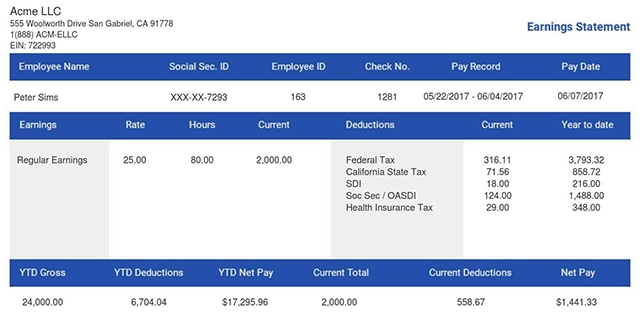
FUTA tax shouldn't be on your paycheck as a deduction. It's an employer-only tax, so nothing is withheld from your pay for it. If you see "FUTA" on a pay stub, it's usually listed as an employer-paid tax for your information, not money taken from your earnings.
Your actual withholding covers FICA (Social Security and Medicare) and income tax. A few states also take a small state unemployment or disability tax from workers. If FUTA is being subtracted from your net pay, ask your employer to fix it.
Business owners making stubs for their team should keep FUTA out of the deductions column for the same reason. You can still show it in an employer taxes section if you like. Health coverage and other payments exempt from FUTA tax can appear as benefits. Need a clean, accurate record for an employee or a loan file? Pick one of our pay stub templates, preview it free, and pay only when you download.
You Might Also Like
- Fit Taxable Wages Explained
- What Is Social Security Wages on a W-2
- How to Read Pay Stub Deduction Codes
- Should Independent Contractors Receive a Pay Stub
- Mandatory Deductions From Your Paycheck
Conclusion: Tracking Payments Exempt From FUTA Tax
Exempt pay comes off the top before the $7,000 cap. Track health coverage, group-term life, employer retirement money, and dependent care as you go. Watch the 2026 changes, especially the new $7,500 dependent care limit. Then line 4 of Form 940 takes minutes, not hours.
Clean pay records make all of this easier, for you and for your employees. Use our paystub generator to build accurate pay stubs with taxes calculated for you.
- 1. Enter Your Information

- 2. Select Your Favorite Theme

- 3. Download Your Stub!

 By