Is Health Insurance Pre Tax? How It Works in 2026
 By
Is health insurance pre tax? For most people with a job-based plan, yes. That matters more than it sounds. In 2025, workers paid about $6,850 a year toward family coverage, according to the KFF Employer Health Benefits Survey. Paying that money before taxes can save you hundreds of dollars a year. Below, we'll explain how the deduction works on your paycheck, when it doesn't apply, and when you can deduct premiums on your tax return. We'll also cover what it means for retirees, business owners, and anyone using pay stubs as proof of income.
Key Takeaways
- Most employer health insurance is paid pre-tax through a Section 125 cafeteria plan.
- Pre-tax premiums lower your federal income tax, Social Security, and Medicare tax.
- Premiums paid pre-tax can't be deducted again on your tax return.
- Self-employed people, small businesses, and retirees have separate deduction rules.
- Your pay stub shows pre-tax status: taxable wages will be lower than gross pay.
- Is Health Insurance Pre Tax?
- Is Health Insurance Pre Tax on Payroll?
- Pre-Tax vs Post-Tax Health Insurance
- When Is Health Insurance Pre Tax and When Is It Not?
- Is Health Insurance Tax Deductible?
- Are Health Insurance Premiums Tax Deductible for Retirees?
- Other Pre-Tax Health Benefits in 2026
- What Pre-Tax Health Insurance Means for Proof of Income
- Conclusion: Is Health Insurance Pre Tax for You?
Is Health Insurance Pre Tax?
Yes, in most cases. When your employer offers coverage through a Section 125 cafeteria plan, your share of the premium comes out of gross pay before federal income tax, Social Security, and Medicare are calculated. Most states follow the same rule. Without a written cafeteria plan, the same deduction is taken after tax.
So, what does pre tax mean for health insurance? It means the premium is subtracted from your pay before taxes are figured. You're taxed on a smaller amount, so you keep more of each check.
The rule comes from Section 125 of the tax code. It lets employees pay for certain benefits with untaxed dollars. The catch is paperwork. Your employer needs a written plan document in place before the plan year starts. If there's no plan, the deduction runs after tax, even if payroll calls it something else.
Are health insurance premiums pre tax for dental and vision too? Usually, yes. The same plan can cover medical, dental, and vision premiums.
Your employer's share works even better. The part your company pays toward your coverage isn't counted as wages at all. You don't pay tax on it, though some stubs show it as an ER Health line for reference.
Is Health Insurance Pre Tax on Payroll?

Yes. Payroll subtracts your health premium from gross wages first, then calculates taxes on what's left. On a $2,500 paycheck with a $150 premium, taxes are figured on $2,350 instead. Your pay stub shows this as federal taxable wages that are lower than gross pay, and your W-2 shows it too.
Taking health insurance pre-tax is all about order. Here's how most payroll systems handle it:
- Start with gross wages for the pay period.
- Subtract pre-tax health insurance deductions.
- Figure federal income tax, Social Security, and Medicare on the lower amount.
- Subtract taxes and any after-tax payroll deductions to get net pay.
A Paycheck Example
Say you earn $2,500 every two weeks, pay $150 per check for coverage, and fall in the 12% tax bracket.
| Item | Paid Pre-Tax | Paid After Tax |
|---|---|---|
| Gross pay | $2,500.00 | $2,500.00 |
| Taxable wages | $2,350.00 | $2,500.00 |
| Social Security and Medicare (7.65%) | $179.78 | $191.25 |
| Federal income tax savings on the premium | $18.00 | $0.00 |
| Tax saved per check | $29.47 | $0.00 |
That's about $766 a year over 26 paychecks. Your employer also skips its 7.65% match on that $150, so the business saves around $298 a year for you alone. State tax savings come on top in most states.
How to Spot It on Your Pay Stub
Not sure your employer takes health insurance pre-tax? Grab a recent stub and check:
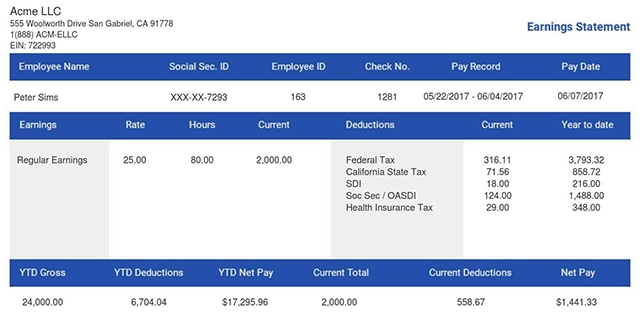
- Look for deduction codes like "Medical Pre-Tax," "Sec 125," or "HI PRE."
- Compare gross pay with the federal taxable wages line.
- Check the year-to-date (YTD) column. Gross YTD minus taxable YTD should roughly match your total YTD pre-tax deductions.
- If the numbers don't line up, ask payroll which code your premium uses.
What Shows Up on Your W-2
Pre-tax premiums lower the wages in Box 1, Box 3, and Box 5. If you earned $65,000 and paid $3,900 in premiums, Box 1 shows $61,100.
You may also see a large number in Box 12 with code DD. That's the total cost of your coverage, including your employer's share. It's for reporting only and isn't taxed. Employers that filed 250 or more W-2s the year before must report it.
Pre-Tax vs Post-Tax Health Insurance
Here's how the two options compare side by side.
| Factor | Pre-Tax | Post-Tax |
|---|---|---|
| When it's deducted | Before income tax and FICA | After taxes are figured |
| Take-home pay | Higher | Lower |
| Taxable income | Lower | Full amount |
| W-2 Box 1 | Reduced | Not reduced |
| Deductible on your return? | No | Only as an itemized medical expense |
| Mid-year changes | Only after a qualifying life event | Usually anytime |
| Who uses it | Most workers on a company plan | Business owners, Marketplace buyers, some special cases |
Which Is Better Pre-Tax or After-Tax Health Insurance?
Pre-tax comes out ahead for most people on a company plan. The tax break shows up on every single check, and you don't have to itemize to claim it. Are health insurance premiums tax deductible if you pay them after tax instead? Only when you itemize, and most people don't.
An after-tax deduction still has a few uses. Disability insurance is the big one. If you pay disability premiums after tax, any benefits you collect later are usually tax-free. Paid pre-tax, those benefits become taxable income.
One more trade-off: lower Social Security wages can slightly shrink future retirement benefits. For most people, the effect is tiny compared with the tax savings.
When Is Health Insurance Pre Tax and When Is It Not?

Pre-tax treatment depends on who you are and how the plan is set up. These cases usually run after tax or follow special rules:
- More-than-2% S corporation owners. Premiums go into Box 1 as wages. The owner can then claim the self-employed health insurance deduction.
- Sole proprietors and partners. They can't join a cafeteria plan at all.
- A domestic partner who isn't your tax dependent. Coverage for that partner is usually taxable to you.
- No Section 125 plan. No plan document means no pre-tax status.
- Marketplace plans. Coverage bought on HealthCare.gov or a state exchange can't be paid pre-tax through a cafeteria plan.
- Some state taxes. A few states don't fully follow the federal rule, so check yours.
Timing matters too. Once you elect pre-tax coverage, you generally can't change it mid-year. Marriage, a new baby, or losing other coverage are common exceptions.
Is Health Insurance Tax Deductible?
It depends on how you pay. Premiums already taken out pre-tax through payroll can't be deducted again. Premiums you pay with after-tax money count as medical expenses, deductible only when you itemize and total medical costs top 7.5% of your adjusted gross income. Self-employed people and employers get their own, more generous deductions.
Is Health Insurance Tax Deductible for an Employee?
Usually not, if your plan runs pre-tax. You already got the tax break through lower withholding. After-tax premiums count only if you itemize on Schedule A. Your total medical costs, including premiums, must top 7.5% of your adjusted gross income (AGI). On $60,000 of AGI, only costs above $4,500 count. IRS Publication 502 lists which costs qualify.
Is Health Insurance Tax Deductible for Self-Employed Workers?
Yes, and it's one of the best deals in the tax code. Freelancers and gig workers can deduct premiums for themselves, a spouse, and dependents on Schedule 1 of Form 1040. You don't need to itemize. There are limits:
- The deduction can't exceed your net profit from the business.
- You can't claim months when you could join a subsidized employer plan, including a spouse's.
- It lowers income tax, but not self-employment tax.
Is Health Insurance Tax Deductible for Small Business Owners?
The money you put toward your team's premiums counts as a regular business expense, same as rent or payroll. It also isn't wages, so you owe no Social Security, Medicare, or federal unemployment tax on it. Letting your team pay their share of health insurance pre-tax trims your payroll tax bill further. Businesses with fewer than 25 full-time equivalent employees may also qualify for the small business health care tax credit. It's worth up to 50% of the premiums you pay for coverage bought through the SHOP Marketplace. IRS Publication 15-B covers the full fringe benefit rules.
Is Private Health Insurance Tax Deductible?
Sometimes. If you buy your own plan, there's no payroll to run it pre-tax. You can deduct it as a medical expense if you itemize, or as a self-employed deduction if you qualify. If you get a premium tax credit, you can only deduct what you actually paid after the credit.
Are Health Insurance Premiums Tax Deductible for Retirees?
Often, yes. Retirees can count Medicare Part B, Part D, and Medigap premiums as medical expenses when they itemize, above the 7.5% of AGI floor. Retirees with self-employment income may deduct them directly instead. Retired public safety officers can exclude up to $3,000 a year paid from a governmental pension.
A few details help retirees save more:
- HSA savings. After 65, HSA withdrawals can cover Medicare premiums with no tax due, but Medigap premiums don't qualify.
- Public safety officers. Retired police officers and firefighters can have the pension plan pay up to $3,000 of premiums each year, tax-free.
- The new $6,000 senior deduction. From 2025 through 2028, people 65 and older can deduct up to $6,000 each, even without itemizing. It isn't tied to health costs, but it helps offset them. It phases out above $75,000 of income ($150,000 for joint filers).
- Part-time business income. A retiree with consulting income may use the self-employed deduction, up to their net profit.
Other Pre-Tax Health Benefits in 2026
Health premiums aren't the only benefit that runs before taxes. Here are the main ones for 2026:
- HSAs. With a high-deductible health plan, you can put in up to $4,400 for self-only coverage or $8,750 for family coverage. People 55 and older can add $1,000.
- Health FSAs. The limit is $3,400, and your plan may let you carry over up to $680.
- HRA reimbursements. Money from a health reimbursement arrangement is tax-free, and it doesn't come out of your pay.
- Dental and vision. These usually run through the same cafeteria plan.
Supplemental plans like accident or hospital coverage are often offered pre-tax too. Just know that cash benefits from some of these policies can become taxable when the premiums were paid pre-tax.
What Pre-Tax Health Insurance Means for Proof of Income
Paying for health insurance pre-tax makes your taxable wages look smaller than your real pay. That surprises a lot of renters and borrowers. Landlords and lenders usually care about gross pay on your proof of income documents, so point them to that line on your pay stub, not Box 1 of your W-2.
Business owners should label each deduction clearly on the stubs they give their team. A line that reads "Medical Pre-Tax" saves everyone a confusing conversation later. Need a clean layout to start from? Our pay stub templates show gross pay, deductions, and YTD totals in one place.
You Might Also Like
- How to Read a W-2 Like a Pro
- How to Calculate W-2 Wages From a Pay Stub
- Payroll Tax vs Income Tax
- What FICA Stands For
- Voluntary Deductions on Your Paycheck
Conclusion: Is Health Insurance Pre Tax for You?
For most workers, health insurance is pre tax, and that saves real money on every check. The key pieces are a Section 125 plan, the right deduction order, and knowing the exceptions. Self-employed workers, business owners, and retirees have their own deduction rules, so match the rule to your situation. Want pay records that show gross pay, deductions, and taxes clearly? Create them in minutes with our paystub generator.
- 1. Enter Your Information

- 2. Select Your Favorite Theme

- 3. Download Your Stub!

 By