

Accrued Hours Meaning: How to Read Your PTO Balance
 By
By
You're looking at your pay stub and there's a line that says something like "PTO Accrued 42.50." You know it's about time off. What you don't know is whether that number buys you five days at the beach or barely one.
Here's the problem with most guides on this topic: they're written for HR managers deciding how generous a policy should be. That's not much help when you're the one holding the stub. The accrued hours meaning you're actually after is simpler, and it's what this guide leads with.
Below you'll find what accrued hours are and how your employer landed on that exact number. You'll also see where the figure lives on your stub, what happens to it if you quit, and how to catch it when it's wrong.
Key Takeaways
- Accrued hours are paid time off you have already earned by working, not time handed to you upfront.
- Your balance grows by a set amount each hour, pay period, or month, based on your employer's accrual rate.
- Accrued does not always mean available, because used time, scheduled time, and waiting periods all reduce what you can actually book.
- Whether unused hours get paid out when you leave depends on your state and your employer's policy, not on federal law.
- Check the accrual figures on every pay stub, since errors are far easier to correct in the month they happen.
- Accrued Hours Meaning: The Short Answer
- Types of Accrued Time Off
- How Accrued Hours Work
- Where to Find Accrued Hours on Your Pay Stub
- How to Calculate Accrued Hours
- What Affects Your PTO Accrual Rate
- Accrued Hours Meaning vs. Available Balance
- Do Accrued Hours Keep Building During Leave?
- What Happens to Accrued Hours When You Leave a Job?
- How to Check Your Accrued Hours Are Correct
Accrued Hours Meaning: The Short Answer
Accrued hours are hours of paid time off you have already earned by working, rather than time your employer hands you upfront. Your balance grows a fixed amount each hour, pay period, or month, then shrinks when you take time off. The number on your pay stub is what you have banked so far.
So what are accrued hours in practice? They're earned, not granted. Every hour you work quietly adds a sliver of paid time to a running total. That total is yours to spend once you're eligible to use it.
They're counted in hours rather than days for a simple reason: employers don't all work the same shift. Eight hours means one day to a full-time office worker and two shifts to someone on a four-hour schedule. Hours are the only unit that stays honest across a mixed workforce.
Type hours accrued meaning into a search bar and you'll land on the same answer: time you've earned and haven't spent yet.
One quick clarification, because the word does double duty. If you came here searching for accrual meaning in the accounting sense, that's a different concept: accrual accounting records revenue and expenses when they're incurred rather than when cash changes hands. Your time off balance has nothing to do with it beyond sharing a root word.
Types of Accrued Time Off

Not every employer tracks time the same way. Some run one combined bank, so your accrued paid time off covers vacation, the flu, and the afternoon you lose at the DMV. So what is accrued time off in that setup? Earned hours sitting in one balance, whatever you end up spending them on. The accrued time off meaning doesn't shift from employer to employer, even when the label does.
Others split the bank. There's accrued vacation meaning the days you've banked for an actual trip. Then there's sick leave accrued separately, which is the category most likely to be governed by a state minimum rather than by company generosity.
That split matters most on your last day, because several states treat accrued vacation time as earned wages while sick time gets no such protection. Public sector and healthcare employers often call the whole balance accrued leave, but the mechanics don't change.
How Accrued Hours Work
So what is PTO accrual, mechanically? Three variables decide everything: the rate, the period, and the cap.
The rate is how much time you earn per unit of work. The period is how often that earning gets posted to your balance, which is usually every pay period. The cap is the ceiling your employer sets, and it's the one most people forget exists.
How does PTO accrual work when you're brand new? Usually there's a gap between earning and spending. Many employers start your accrual on day one but block you from using any of it for the first 30 to 90 days. Others delay the accrual itself. Your handbook will say which, and the two produce different balances at the six-month mark.
Under an accrual PTO policy, hours accrued keep stacking until you either use them or hit that cap. Once you hit it, accrual stops dead. It doesn't queue up and pay out later. You simply stop earning until you take time off and drop back below the limit.
Where to Find Accrued Hours on Your Pay Stub

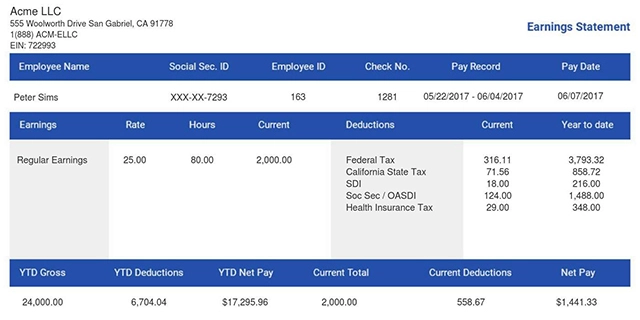
Look below your earnings and deductions. Most payroll systems print a small accrual block near the bottom of the stub. It's often labeled with a code rather than a word: PTO, VAC, SICK, or ETO.
That block almost always carries three numbers, and confusing them is the single most common misread:
- Accrued this period. What you earned in this pay cycle alone. On a biweekly stub with a 120-hour annual plan, expect something near 4.62.
- Used year to date. What you've already taken since the plan year started.
- Current balance. What's actually left. This is the number that matters.
To turn that balance into something meaningful, divide by your normal shift length. A balance of 42.50 hours is a little over five days for someone on 8-hour shifts. For someone working 12s, it's about three and a half days.
One caveat worth knowing: not every employer prints accrual on the stub at all. Some show it only inside the employee self-service portal. If your stub has no accrual block, that's usually where it's hiding.
Need pay documentation for a rental application or loan and your employer's records are thin? Our pay stub templates make it straightforward.
How to Calculate Accrued Hours
The base formula is short: hours worked times your accrual rate equals hours accrued.
The rate is where people get stuck, and it's just division. Take your annual allowance in hours and divide by the standard work year of 2,080 hours. That's 40 hours a week across 52 weeks. Here's how to calculate PTO accrual per hour for someone with 15 days off:
120 hours per year divided by 2,080 hours worked = 0.0577 hours of PTO per hour worked.
Work a 40-hour week at that rate and you bank about 2.31 hours every week. You don't need a PTO accrual calculator for this. It's two numbers and a division sign.
How Many Vacation Hours Accrued Per Week, Month, or Pay Period
Same 120-hour annual allowance, sliced five different ways. Find your pay frequency:
| Accrual basis | Periods per year | Hours accrued per period |
|---|---|---|
| Per hour worked | 2,080 hours | 0.0577 |
| Weekly | 52 | 2.31 |
| Biweekly | 26 | 4.62 |
| Semi-monthly | 24 | 5.00 |
| Monthly | 12 | 10.00 |
How is vacation time accrued if you're part-time? Identical rate, fewer hours behind it. At 20 hours a week instead of 40, that same 0.0577 rate earns you 1.15 hours per week rather than 2.31. Nobody lowered your rate. You just fed it half the input.
To convert any balance back into days off, divide by your shift length. Sixty hours at 8 hours a day is 7.5 days. The same conversion logic applies when you calculate your hourly, weekly, and monthly income.
What Affects Your PTO Accrual Rate
PTO accrual rates aren't standardized, and four things move the number.
Employment status comes first. Full-time staff typically accrue at the headline rate, part-timers earn proportionally less, and temporary or contract workers often accrue nothing at all.
Tenure comes second. Most employers reward longevity with a step up at set anniversaries. Bureau of Labor Statistics figures from March 2025 show 31% of private industry workers got 10 to 14 paid vacation days after one year, and 31% got 15 to 19 after ten years.
Employer size matters more than people expect. BLS puts paid vacation access at 91% for workers in private industry establishments with 500 or more workers, against 71% in the smallest ones with 1 to 49.
State law sets the floor for sick time. State pay stub laws also govern what your employer must show you in writing. Many state paid sick leave statutes set a minimum accrual of one hour for every 30 hours worked, though rates vary: Washington and Illinois use one per 40, Rhode Island one per 35. That floor holds no matter what the average PTO accrual rate looks like in your industry. Your employer's PTO accrual policy can be more generous than the law. It can't be less.
Accrued Hours Meaning vs. Available Balance
These four terms get used interchangeably, and they aren't interchangeable. Take one person on a 120-hour plan, halfway through the year:
| Term | What it means | Their number |
|---|---|---|
| Accrued | Total earned to date | 60 hours |
| Used | Already taken | 16 hours |
| Outstanding | Requested, not yet approved or taken | 8 hours |
| Available | Accrued minus used minus scheduled | 36 hours |
They've accrued 60 hours. They can realistically book 36. On 8-hour days, that's a three-day gap between the headline figure and reality. It's exactly how people end up requesting time they don't have.
Lump sum works the other way around. Under a front-loaded plan, your full accrued paid time off arrives on January 1 and you spend it down. Nothing accrues at all. Unlimited PTO skips the arithmetic entirely, since there's no balance to track.
Do Accrued Hours Keep Building During Leave?
It depends on whether the leave is paid. While you're using paid time off, you normally stay in paid status and keep accruing at your usual rate. During unpaid leave, including unpaid FMLA leave, most employers pause accrual until you return to work.
The logic is consistent once you see it. Accrual is tied to working or being paid as though you're working. Take a paid vacation day and the meter keeps running. Take an unpaid month of leave and it generally stops.
A few specifics worth knowing. Under the Family and Medical Leave Act, your employer has to maintain your group health coverage during protected leave. Federal law doesn't require them to keep your time off accruing. What it does require is consistency: they must treat FMLA leave the same as any comparable unpaid leave.
Short-term disability leave usually pauses accrual too, unless you're topping up disability payments with your own accrued leave. During that paid portion, accrual typically continues.
What Happens to Accrued Hours When You Leave a Job?
That depends on your state and your employer's policy, because no federal law requires paid vacation. Some states treat accrued time off as earned wages that must be paid out at separation. Others allow employers to set use-it-or-lose-it rules, as long as the policy is documented and communicated in advance.
Broadly, state rules fall into three patterns:
- Accrued time is earned wages. The balance is compensation you already worked for, so it has to appear in your final paycheck. Forfeiture clauses don't hold up.
- Use-it-or-lose-it is permitted, with conditions. Employers can wipe unused time at year end or at separation, but usually only where the policy was written down and communicated first.
- Silent on the question. Your handbook governs, which makes reading it before you resign a genuinely profitable use of ten minutes.
Rollover caps work the same way at year end. A plan might let you carry five days into next year and quietly delete the rest on December 31.
State leave requirements keep shifting through 2026. Check your state labor department for current rules rather than trusting any list, including this one, to stay accurate.
How to Check Your Accrued Hours Are Correct
Start with the arithmetic. Multiply the hours you worked this period by the accrual rate in your handbook. Compare that to the "accrued this period" figure on the stub. Those two numbers should match. When they don't, one of four things is usually going on:
- You're reading the year-to-date accrued figure as your current balance. They're different columns.
- You're treating hours as days. A 40-hour balance is one week, not 40 days off.
- Time you requested and got approved hasn't been deducted yet, so the balance looks healthier than it is.
- You quietly hit a balance cap, and accrual stopped without any notification.
If none of those explain the gap, escalate in order: handbook first, then payroll, then HR. Bring the specific stubs and the dates. A documented discrepancy gets fixed considerably faster than a vague sense that something's off.
The habit that saves people real money is checking every pay period rather than once a year. A rate entered wrong in January costs you a few hours by February, and your stubs prove it. Left alone until December, the same error is worth days and far harder to reconstruct.
You Might Also Like
- Does PTO Count Towards Overtime?
- Negative PTO: What Happens When Your Balance Goes Below Zero
- Leave of Absence: How It Affects Your Benefits
- How Many Hours Is Part-Time?
- Overtime Calculator: Work Out Your Extra Pay
Conclusion
That number on your stub isn't a perk your employer is offering. It's time you already worked for, converted into hours and parked in a balance. Once you know your accrual rate, you can predict it, verify it, and spot the month it goes wrong.
Two habits are worth building. If you're an employee, recalculate the balance once a pay period and keep the stubs. If you run payroll for a small team, print the rate and the balance somewhere your people can actually see them. Most accrual disputes are really just visibility problems.
Need clean, professional pay records that show earnings and time off clearly? Our paystub generator builds them in minutes.
- 1. Enter Your Information

- 2. Select Your Favorite Theme

- 3. Download Your Stub!

 By
By