

How Does PTO Accrue? Rates, Math, and Caps (2026)
 By
By
Most people meet their PTO balance as a number on a pay stub. It went up by a few hours, nobody explained why, and the policy that governs it is buried in an onboarding folder. So how does PTO accrue, and where does that number come from?
Short version: your employer picks a rate, then applies it either to the hours you work or to the time that passes. This guide covers both methods and the math behind a typical rate. Need your own records? Our pay stub generator creates them in minutes. You'll also see what 120 hours looks like in real days off, which caps quietly stop you from earning, and how to check the balance on your own stub.
Key Takeaways
- PTO accrues one of two ways: per hour worked, or per period of time passed
- A common full-time rate is 0.0577 hours of PTO per hour worked, which equals 15 days a year
- Accrual rate multiplied by hours worked equals what should appear on your stub each period
- Caps, waiting periods, and rollover limits can quietly stop you from earning
- 120 hours of PTO equals 15 eight-hour days, or three work weeks
- How Does PTO Accrue?
- What Is Accrued PTO?
- How Does PTO Accrue Under Different Policy Types?
- How to Calculate Your PTO Accrual Rate
- 120 Hours of PTO Is How Many Days?
- What Affects How Fast You Accrue PTO?
- Does PTO Accrue While You're on Leave?
- Caps, Rollover, and PTO Payouts
- How to Check Accrued PTO on Your Pay Stub
- Do Contractors and the Self-Employed Accrue PTO?
How Does PTO Accrue?
PTO accrues in one of two ways: per hour worked, or per period of time passed. Hourly staff typically earn a set fraction of an hour for every hour on the clock, such as 0.0577 hours. Salaried staff usually earn a flat amount each pay period, such as 4.62 hours every two weeks.
Which method applies to you depends on how you're paid. Hourly staff get the hours-worked version, because it scales with a schedule that changes week to week. Salaried staff get the flat per-period version, which is predictable and doesn't punish a light week. How is PTO accrued when a state or local sick leave law applies? Many of those laws mandate the hours-worked method, commonly one hour per 30 or 40 hours worked. They also set a floor your employer can beat but can't undercut.
So how does PTO accrue for someone whose hours swing seasonally? Under the hours-worked method, a slow quarter means a smaller balance. Under the per-period method, the number doesn't move at all.
What Is Accrued PTO?

Accrued PTO is paid time off you have already earned but have not yet used. It is different from available PTO, which subtracts hours you have taken or already scheduled. The formula employers use is straightforward: total accrued hours, minus hours used, minus hours scheduled, equals what you can actually book.
Three numbers get blurred on most HR dashboards, and mixing them up is how people request a week they haven't earned. Accrued is what you've banked. Used is what you've taken. Available is what's bookable today.
Most definitions of the accrued PTO meaning stop halfway, treating it as interchangeable with the balance you can spend, and that is where people get tripped up. So how does accrued PTO work once you've booked a trip? Most systems subtract scheduled hours the moment a request is approved, which is why your available balance drops weeks before you leave.
Front-loaded plans invert this, granting the full annual allotment on day one so nothing builds gradually.
How Does PTO Accrue Under Different Policy Types?
Those two mechanics are the engine. Employers build five common shapes on top of them.
Per Hour Worked
You earn a fixed fraction of an hour for every hour on the clock. It's standard for hourly and part-time employees, and the method most state sick leave laws require. Overtime may or may not count, so check your handbook.
Per Pay Period
A flat amount lands each payday regardless of hours. How is PTO accumulated here? Twenty-six deposits a year on a biweekly cycle, 24 on a semi-monthly one, so it helps to know how your pay period is structured. Salaried employees usually land in this bucket.
Lump Sum and Front-Loaded PTO
Your whole annual allotment arrives at once, typically on January 1 or your work anniversary. Generous early, though employers often pair it with a clawback if you leave before earning it out.
Tiered PTO Accrual
The rate climbs with tenure: 10 days for a new hire, 15 at five years, 25 for a 20-year veteran. How do you accumulate PTO faster here? Time served. That's the entire lever.
Bonus and Unlimited PTO
Bonus PTO is extra hours for performance, referrals, or attendance. Unlimited PTO removes accrual altogether, so how does PTO accumulate under it? It doesn't. Nothing banks, nothing carries over, and in most states nothing pays out when you leave.
How to Calculate Your PTO Accrual Rate

How does PTO accrue in actual numbers? Start from the annual allotment, then divide by whichever unit your employer meters.
Say your policy grants 15 days and you work full time. Fifteen days at eight hours is 120 hours, which produces three different-looking rates:
- Per hour worked: 120 ÷ 2,080 hours = 0.0577 hours per hour worked
- Per biweekly pay period: 120 ÷ 26 = 4.62 hours per paycheck
- Per semi-monthly pay period: 120 ÷ 24 = 5 hours per paycheck
All three reach the same 120 hours by December.
| Annual Allotment | Total Hours | Per Hour Worked | Biweekly | Semi-Monthly |
|---|---|---|---|---|
| 10 days | 80 | 0.0385 | 3.08 | 3.33 |
| 15 days | 120 | 0.0577 | 4.62 | 5.00 |
| 20 days | 160 | 0.0769 | 6.15 | 6.67 |
| 25 days | 200 | 0.0962 | 7.69 | 8.33 |
Part-Time Proration
How does PTO accrual work on a reduced schedule? The per-hour rate usually stays identical and simply generates less. At 0.0577 and 20 hours a week, you'd bank roughly 60 hours a year instead of 120. The same arithmetic drives your hourly, weekly, and monthly income.
The Reverse Check
Run the math backwards to audit your stub. Your accrual rate multiplied by hours worked this period should equal the increase in your balance. At 0.0577 with 80 hours on the check, expect 4.62 hours. If the stub shows 2.5, something's misconfigured, and payroll is the place to ask.
120 Hours of PTO Is How Many Days?
120 hours of PTO equals 15 days, or three full work weeks, for someone on a standard eight-hour schedule. The math is simply 120 divided by 8. If you work ten-hour shifts, that same 120-hour balance covers 12 days off instead, because each day off costs more hours.
| Hours Banked | 8-Hour Days | Work Weeks |
|---|---|---|
| 40 | 5 | 1 |
| 80 | 10 | 2 |
| 120 | 15 | 3 |
| 160 | 20 | 4 |
| 200 | 25 | 5 |
| 240 | 30 | 6 |
A day off costs whatever your scheduled shift costs. Four tens a week means 40 banked hours buys four days, not five.
What Affects How Fast You Accrue PTO?
Four things set your PTO accrual rate: employment status, length of service, your employer's waiting period, and state law. No federal law requires paid time off at all, so rates vary widely. Bureau of Labor Statistics data from March 2025 shows 31% of private-industry workers earned 10 to 14 days of paid vacation after one year.
Start with the legal floor, because there effectively isn't one. The Department of Labor is blunt about it. The Fair Labor Standards Act "does not require payment for time not worked, such as vacations, sick leave or federal or other holidays." Those benefits, in the DOL's words, "are matters of agreement between an employer and an employee."
Employment Status
Full-time employees accrue at the highest rate, while part-time and seasonal staff often accrue pro rata or not at all. So how do you get PTO if you're classified as temporary? Frequently you don't, unless a state or city ordinance reaches you.
Length of Service
Tenure tiers are standard, and BLS figures from March 2025 show the whole ladder. At five years of service, the largest group of private-industry workers, 32%, sits at 15 to 19 days of paid vacation, and it holds there at ten years with 31%. Reach twenty years and the biggest bracket, 33%, is getting more than 24 days.
Waiting Periods
Employers commonly separate the date you start banking hours from the date you can spend them, often a 90-day probationary period. How do you earn PTO during that window? You usually accrue normally and just can't book anything yet. Requirements differ by state, and state pay stub laws decide what your employer has to show you.
Industry and Employer Size
How does PTO accrue differently from one employer to the next? Industry moves the odds more than people expect: paid vacation reaches 96% of manufacturing workers but only 46% in leisure and hospitality. PTO accrual rates tend to track company size as well, and so does whether you get vacation at all. 71% of workers at the smallest employers, those with 1 to 49 people, have access, against 91% at employers with 500 or more staff. The average PTO accrual rate at a 20-person shop is a different conversation entirely.
Does PTO Accrue While You're on Leave?
It depends on whether the leave is paid. When you take PTO, you stay in paid status, so accrual normally continues at your usual rate. During unpaid leave, including unpaid FMLA leave, most employers pause accrual until you return. Federal law does not require accrual to continue during unpaid leave.
Sick Leave and PTO
When paid sick leave sits in its own bucket, using it doesn't touch your PTO balance. Under a consolidated plan, one balance covers both, and every sick day draws down hours you'd otherwise spend on vacation.
FMLA and Disability Leave
How does PTO accrue during twelve weeks of FMLA? The Family and Medical Leave Act protects your job, not your accrual. Employers must treat FMLA leave like comparable unpaid leave, so if accrual pauses for unpaid absences generally, it pauses here. Many people substitute accrued PTO to stay in paid status, which keeps accrual running. The rules shift again for a longer leave of absence.
Caps, Rollover, and PTO Payouts
How does PTO accrue once you hit a cap? It stops. Four levers decide what happens to hours after you earn them.
Accrual Caps
Most policies set an accrual cap, often 1.5 to 2 times the annual allotment. Reach it and you stop accruing PTO until you spend some down. Nobody sends a warning, so if your balance hasn't moved in two months, check the cap.
Rollover and Use-It-or-Lose-It
How does PTO accrue across the turn of a year? Some employers carry the full balance into January, some cap carryover, and some zero it out. Several states restrict use-it-or-lose-it outright, so the answer depends on where you work.
Payout at Separation
Whether unused hours get cashed out when you leave is state-specific. Some states treat accrued PTO as earned wages that must be paid; others defer to the employer's written policy. Either way the money is income, so it's worth knowing how PTO is taxed before you count on a PTO payout.
Negative Balances
Some employers let you borrow against future PTO accruals. Leave with a negative PTO balance and many will deduct it from your final paycheck, where state law allows.
For business owners, those four levers are your policy. Write them down, because an unwritten cap is the one employees dispute.
How to Check Accrued PTO on Your Pay Stub
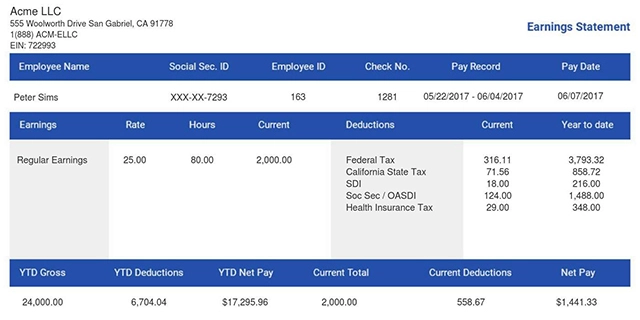
How does PTO accrue according to payroll rather than the handbook? Your pay stub is the record of what actually happened, because payroll generates it instead of someone typing a number into a dashboard.
Look in the earnings or leave section, below the gross pay breakdown. Labels vary: PTO, Vacation, Leave Balance, or an abbreviation like VAC or PTO ACCR. If the shorthand is unfamiliar, our guide to pay stub deduction codes decodes the rest of the line items. A well-built stub shows three figures: accrued this period, used this period, and available balance.
The stub reflects the pay period it covers, so it can trail your HR portal by a full cycle. A day you took yesterday probably isn't on it yet. Portal balances also tend to include scheduled-but-not-taken hours while the stub doesn't. When the two disagree, the stub usually wins.
Make it quarterly: pull your last three stubs, multiply your accrual rate by the hours on each, and confirm the increases match. Ten minutes, four times a year, catches a misconfigured rate while it's still fixable.
Business owners, the same line matters from your side, since stubs that omit the accrual balance generate a support question every pay period. Need pay records that spell out the details? Our pay stub templates make it straightforward.
Do Contractors and the Self-Employed Accrue PTO?
No. Independent contractors and self-employed workers do not accrue PTO, because accrual is a benefit tied to employment. Any time off you take is unpaid, and it reduces your income for that period. That makes consistent income documentation more important when a landlord or lender asks for proof.
How does PTO accrue for a 1099 contractor? It doesn't, and that cuts both ways. Working solo, you're self-funding every day off, so price it into your rates, and check whether 1099 contractors should receive pay stubs for your own records. Hiring contractors, classification is the whole question: misclassify an employee and you've skipped an accrual obligation a state agency can assess later.
You Might Also Like
- Does PTO Count Towards Overtime?
- What Is Unlimited PTO?
- Unpaid PTO: How It Works
- Negative PTO Balances Explained
- Free PTO Policy Template
Conclusion
How does PTO accrue? Two mechanics, one formula, and a handful of rules that decide what happens to the hours afterward. Your employer meters time either by hours worked or by periods passed. Your rate is the annual allotment divided by that unit, and caps and rollover limits determine what survives into next year.
The habit worth building is small. Check the accrual line on your stub each quarter and run the reverse-check math once. It takes ten minutes and catches a rate that was set up wrong months ago.
Need clean pay records with the accrual details spelled out? A reliable paystub generator creates professional pay stubs in minutes.
- 1. Enter Your Information

- 2. Select Your Favorite Theme

- 3. Download Your Stub!

 By
By