

Proof of Income for Students: 8 Documents That Work (2026)
 By
By
Whether you're applying for your first credit card, signing a lease near campus, or completing a FAFSA verification request, proof of income for students comes up sooner than most people expect. Unlike full-time workers with a steady paycheck, students often draw income from several sources at once: part-time jobs, family support, financial aid, which makes knowing what documentation actually qualifies especially important.
For students with part-time or gig work, creating professional pay stubs at ThePayStubs.com takes under two minutes. This guide covers every document that counts, what to do when your income is limited or nontraditional, and how to prepare for whichever institution is asking.
Key Takeaways
- Pay stubs, bank statements, and tax returns are the most widely accepted proof of income documents for students.
- Students under 21 can list allowances and remaining scholarship funds (not student loans) on credit card applications.
- Financial aid award letters count for apartment applications and credit cards when no job income exists.
- Combining part-time earnings, family support, and leftover financial aid often meets a landlord's 2–3× rent requirement.
- ThePayStubs.com lets students with part-time or freelance work generate professional pay stubs in minutes.
What Is Proof of Income for Students?
Proof of income for students is official documentation showing how much money you receive, whether from a part-time job, family allowance, financial aid, or scholarship. Landlords, credit card issuers, and financial aid offices use it to verify you can meet financial obligations. Students typically qualify using one or more documents combined.
Most college students draw income from nontraditional sources: work-study programs, campus jobs, freelance gigs, tutoring, or regular parental support. The good news is that most institutions accept these sources as long as they're properly documented. Understanding proof of income for students simply means knowing which proof of income documents to gather before the application, and this guide walks through all of them.
8 Documents That Count as Proof of Income for Students
When applying for an apartment, most landlords expect gross income equal to two to three times the monthly rent. For students, that threshold becomes easier to meet by combining multiple income sources. The eight documents below cover the broadest range of proof of income for students, accepted by landlords, lenders, and credit card issuers alike.
Pay Stubs
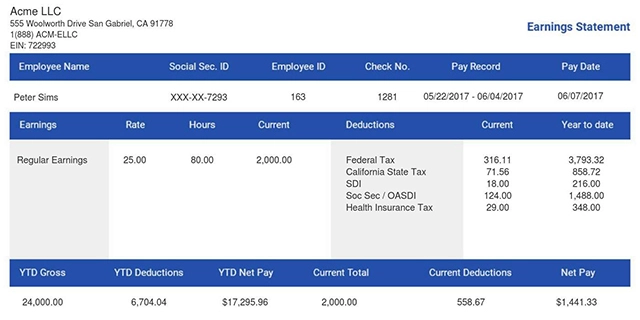
If you have a part-time or campus job, bring two to three of your most recent pay stubs. Each stub shows gross pay, net salary, your employer's information, and the pay period, which is precisely what landlords need for employment verification and proof of income documentation. If your employer doesn't issue formal pay stubs, a pay stub generator can create a properly formatted document for you.
Tax Returns or 1099 Forms
Freelancers, self-employed students, and gig workers (tutoring, delivery, rideshare) should use their most recent federal tax return (Form 1040). Employees who received a W-2 form can use it to show annual wages. Students with contractor income can present a 1099-NEC instead. These reflect total yearly income, which helps when individual bank deposits look irregular.
Bank Statements
Two to three months of bank statements work well when no formal pay stub exists. Landlords and lenders look for regular, repeating deposits from an employer, monthly family transfers, or financial aid disbursements. Highlight those recurring deposits before submitting so reviewers can spot the pattern easily.
Financial Aid Award Letter
Issued by your school's Financial Aid office, an award letter documents the scholarship, grant, and remaining aid amounts available to you after tuition. Many landlords and some credit card issuers accept remaining aid disbursements as countable income. You can request a current award letter through your school's student financial services portal.
Employer Letter or Offer Letter
If you've accepted a new job but haven't received your first pay stub yet, a signed offer letter on company letterhead (listing your position, start date, and salary or hourly rate) serves as valid income documentation during the transition period.
Scholarship or University Funding Letter
A signed letter from your university or scholarship organization clearly stating the dollar amount and funding period is widely accepted by U.S. landlords. It can be submitted as a PDF, scan, or clear smartphone photo. Make sure it includes your name, the funding amount, and the dates covered.
Parental Support Documentation
Regular deposits from a parent count as income when they come directly into an account in your name. Pair two to three months of bank statements (showing the deposits) with a brief signed letter from the parent confirming the monthly support amount. Landlords vary on this requirement, but many accept it when the deposits are consistent.
Generate Professional Pay Stubs with ThePayStubs.com
For students with part-time jobs, freelance work, or gig income, ThePayStubs.com creates formatted, professional pay stubs in under two minutes. Enter your hours, hourly rate, and employer details, and a properly formatted PDF is ready to download immediately. Many landlords accept pay stubs generated this way for income verification from non-traditional workers.
What Counts as Income for Student Credit Card Applications?

Income requirements for credit cards work differently from apartment applications, and the rules for proof of income for a credit card are determined by your age under federal law.
If You're Under 21
Under the CARD Act of 2009, students under 21 must show income they personally control — such as part-time wages, work-study earnings, or a regular allowance deposited into their account. Parents' income does not count unless a parent co-signs the application. As of 2026, these rules remain unchanged. Student loans are excluded.
The practical test is simple: "Can I independently repay this debt?" If the answer is yes, the income counts. A work-study paycheck qualifies. A monthly allowance deposited to your account qualifies. Your parents' household income does not, unless they're willing to formally co-sign.
If You're 21 or Older
At 21 and older, applicants can report household income — including a spouse's or partner's earnings, provided you have reasonable access to those funds. Graduate students can list teaching assistant or research assistant stipends as employment income. Freelance income supported by bank statements or a 1099-NEC also qualifies. Even $100 to $200 per month in consistent, documented deposits is often enough to qualify for a low-limit starter student credit card.
What Doesn't Count as Proof of Income?
Knowing which sources fall short is just as important as knowing which documents qualify when preparing proof of income for students. A few sources that seem valid will not hold up under review:
- Student loans: Loans are debt you must repay, not earnings — virtually all lenders and most landlords exclude them from income calculations.
- Unverified cash: Informal payments with no documentation are rarely accepted. Even if you're paid in cash, you'll still need bank records or signed statements to document that income.
- Savings alone: A large savings balance shows financial stability but doesn't demonstrate cash flow. Some landlords accept 3–6 months' rent held in savings as a workaround, but it's not a universal substitute for income.
- Fabricated income: Misrepresenting income on a credit or rental application is fraud. The legal and financial risks far outweigh any short-term benefit.
What If You Have No Income as a Student?

No traditional income doesn't mean no options. Most students in this situation have at least one viable path forward. Students applying for SNAP benefits need similar proof of income for food stamps documents.
Get a co-signer. A parent or family member who co-signs the lease or credit card application lets the lender or landlord evaluate their income and credit history instead. This is the most common solution for students without independent income. If your co-signer needs to provide pay stubs for the loan application, make sure they have recent documentation ready as well.
Use a guarantor service. Guarantor companies charge a one-time fee (typically equal to one to two months' rent) to back your lease. This is especially practical for international students or those without a U.S.-based co-signer.
Become an authorized user. Being added as an authorized user on a parent's credit card builds your credit score over time without requiring your own income proof, making future standalone applications easier to approve.
Offer a larger security deposit. Some landlords waive income verification entirely in exchange for two to three months' rent paid upfront at signing.
Combine multiple sources. Part-time earnings, a consistent monthly allowance, and leftover scholarship funds together often reach the standard 2–3× rent income threshold, even when each source alone falls short of the target.
Conclusion
The range of accepted proof of income for students is wider than most expect. Combining part-time earnings, regular family support, and financial aid can satisfy both landlords and credit card issuers even without a traditional full-time job. The key is knowing which documents to gather before the application lands in front of you.
If you work part-time, freelance, or take on gig work, use our pay stub generator to create professional income documentation in minutes. ThePayStubs.com makes it simple to document your earnings, whatever your income source looks like.
You Might Also Like
- 1. Enter Your Information

- 2. Select Your Favorite Theme

- 3. Download Your Stub!

 By
By