

What Is a Salary Band? Pay Ranges Explained (2026)
 By
By
Somebody hands you a number. The job posting says $70,000 to $85,000. Or your manager mentions that you're "in the middle of your range." Nobody explains what that actually means. That range has a name. It's a salary band, and there's a specific logic behind where those two numbers came from.
A salary band is the pay range an employer sets for a role or job level. It matters on both sides of the desk. For a small business owner documenting pay with a pay stub generator, it's the difference between defensible offers and guesswork. For an employee, it tells you how much room is left before you need a promotion rather than a raise.
Here's what's ahead. We'll break down the three numbers in a band and show you how to find where your own salary sits. Then we'll cover building bands from scratch without a survey budget, real examples with dollar figures, and the mistakes that catch out first-time band builders.
Key Takeaways
- A salary band has three numbers: a minimum, a midpoint, and a maximum. The midpoint normally reflects the market rate for the role.
- Divide your salary by the midpoint to get your compa ratio. Below 1.0 means you sit under market for your level.
- Overlapping bands are normal design, which is why a promotion sometimes arrives without an immediate raise.
- The Bureau of Labor Statistics publishes free wage data by occupation and metro area. A paid salary survey is not required to build your first bands.
- Re-benchmark at least once a year, and sooner if a minimum wage increase climbs past your band floor.
- What Is a Salary Band?
- How Pay Banding Works in Practice
- Why Salary Bands Matter for Workers and Employers
- How to Create Salary Bands in Six Steps
- Salary Band Examples With Real Numbers
- Salary Bands vs. Pay Grades and Pay Scales
- Common Salary Band Mistakes and How to Fix Them
- Keeping Your Bands Current
- What Pay Transparency Means for Your Pay Documents
- Conclusion: Making Salary Bands Work for You
What Is a Salary Band?
A salary band is the pay range an employer sets for a role or job level. The band is defined by three numbers: a minimum, a midpoint, and a maximum. The midpoint usually reflects the market rate. Your actual salary sits somewhere inside that range based on experience and performance.
Each number does a different job:
- Minimum. The floor for the role. It's where someone new to the job or light on experience typically starts.
- Midpoint. The target rate for someone fully competent in the role. The salary midpoint is the anchor, and it's normally pulled straight from market data.
- Maximum. The ceiling. It's reserved for deep experience, rare skills, or sustained high performance.
The distinction that trips people up: a band belongs to a role, not to a person. Two people doing the same job at the same level share one band. They'll sit at different points inside it depending on tenure, skills, and results. Your salary is a point. The band is the range that point lives in.
Pay Band Meaning and Other Names for the Same Thing
This one causes more confusion than it should, because there's nothing extra to learn. A pay band is a salary band. Some employers write paybands as one word, others say salary range or compensation band, and public sector organizations often say pay scale. The structure underneath is identical: a floor, a target, and a ceiling attached to a role.
How Pay Banding Works in Practice

The process starts by grouping jobs that carry similar scope and responsibility, then attaching one range to that group. Higher levels get higher bands. A coordinator, a manager, and a senior manager each sit in their own band.
Here's the part that surprises people: bands overlap on purpose. The top of the coordinator band often sits above the bottom of the manager band. That overlap exists for two reasons. A strong performer can keep earning more without needing a title change. And a promotion doesn't force an automatic jump in pay.
Finding Where You Sit in Your Band
If you know your band, you can measure your position in about ten seconds. Divide your salary by the band midpoint. That number is your compa ratio.
A compa ratio of 0.90 means you're 10% below the midpoint, which is common for someone still growing into a role. Land on 1.0 and you're paid at market for your level. Push above 1.0 and you're ahead of the midpoint, which usually signals strong performance or a skill the employer is protecting.
Some employers use salary range penetration instead, which measures how far you've traveled from the minimum to the maximum rather than comparing you to the midpoint. Either way, the useful question at your next review isn't "can I have more money." It's "where am I in the band, and what moves me toward the midpoint."
That framing turns a raise request into a conversation about career progression. It's how salary bands work at their best: a merit increase moves you through the band, and a promotion moves you to the next one.
Why Salary Bands Matter for Workers and Employers
Salary banding gives you a defensible answer when someone asks why two people in similar roles earn different amounts. Without that structure, pay decisions get made one at a time, under deadline pressure, by whoever happens to be in the room. That's how pay gaps form without anyone intending them, and it's why the difference between payroll and compensation matters more than the labels suggest.
For an employer, the wins stack up fast:
- Consistency. Offers stop depending on who negotiates hardest.
- Budget forecasting. Headcount costs become predictable because every planned hire has a known range.
- Pay equity. Bands make outliers visible. If everyone in one demographic sits in the bottom quartile of the same band, you can see it and fix it.
- Documentation. When a pay decision gets questioned, you have a rationale on file.
For an employee, the value is simpler. A band tells you the ceiling before you walk into a negotiation. It also shows the shape of the path ahead. You can see how much room is left at this level, and what the jump to the next band pays.
How to Create Salary Bands in Six Steps

Building your first set of salary bands takes a weekend, not a quarter.
Step 1: Group Roles into Families and Levels
Sort your jobs into families, such as operations, sales, or engineering. Inside each family, define levels by scope: how much decision-making authority the role carries, whether it leads people, and what experience it genuinely requires. Write those definitions down as job descriptions. That structure, often called job architecture, is what makes internal equity checkable later. Vague levels produce vague bands.
Step 2: Pull Market Data
Salary benchmarking means comparing each role against what employers actually pay, segmented by location and company size. No budget for a paid compensation survey? The Bureau of Labor Statistics publishes wage data by occupation and metropolitan area at no cost. You get percentile breakdowns too, and those feed directly into the next step.
Step 3: Set the Midpoint
Pick your target percentile and make it the midpoint. Targeting the 50th percentile means you intend to pay at the market median. Targeting the 75th percentile means you're paying above most competitors to win scarce talent. Your compensation strategy and compensation philosophy drive this call, and plenty of employers target the 50th for most roles while going higher for a handful of hard-to-fill ones.
Step 4: Set the Range Spread
Decide how wide the band runs on either side of the midpoint. Around 15% each way is the most common choice, which produces enough room for several years of progression before someone hits the ceiling. Narrower bands control cost but generate outliers quickly. Wider bands offer flexibility but blur the line between levels.
Step 5: Check the Legal Floor
Before you lock in a minimum, confirm it's lawful. Under federal Department of Labor rules, an employee generally has to be paid at least $684 a week, or $35,568 a year, and meet a duties test, to be exempt from overtime. Salary alone doesn't settle it. Several states set a higher exempt salary floor, and your state or city minimum wage may sit well above the federal floor too. The stricter standard governs. A band minimum that dips underneath the applicable floor isn't merely uncompetitive, it's a compliance problem. The Department of Labor publishes the current thresholds.
Step 6: Adjust for Location, Then Document It
If you pay differently by geography, build a separate band set for each key market or apply a location multiplier that reflects cost of living. Remote staff need a stated rule too. Then write the whole thing down and tell your managers how it works. A band nobody understands gets ignored the first time a hiring manager feels pressure.
Salary Band Examples With Real Numbers
Say you're setting a salary band for a mid-level operations manager. Your market research puts the going rate at $76,000, so that becomes the midpoint. Bands are written as an annual salary figure, and you choose a 15% spread.
- Minimum: $76,000 x 0.85 = $64,600
- Midpoint: $76,000
- Maximum: $76,000 x 1.15 = $87,400
Now say you're paying someone $70,000 in that role. Divide that by the $76,000 midpoint and you get a compa ratio of 0.92. They're roughly 8% under market for the level, which tells you precisely what the next review conversation needs to cover.
Stack three levels together and the overlap becomes visible:
| Level | Minimum | Midpoint | Maximum |
|---|---|---|---|
| Operations Coordinator | $48,000 | $56,500 | $65,000 |
| Operations Manager | $64,600 | $76,000 | $87,400 |
| Senior Operations Manager | $82,000 | $96,500 | $111,000 |
A coordinator at the top of their band earns more than a manager at the very bottom of theirs. That's not a mistake, it's the overlap doing its job.
One caveat: bands like these cover base salary only. Bonuses and equity sit outside the band, inside your total compensation package.
For a public reference point, the federal government's General Schedule is a real banded system covering roughly 1.5 million white-collar civilian employees. It runs 15 grades, each with 10 steps. In 2026, the base scale runs from $22,584 at the bottom of GS-1 to $164,301 at the top of GS-15. Those are base rates, before the locality adjustment that nearly every GS employee gets on top. The Office of Personnel Management publishes the full tables for each January, so anyone can check the numbers.
Salary Bands vs. Pay Grades and Pay Scales
Some of the confusion around salary bands meaning comes from three neighboring terms that get swapped around.
| Term | What it actually is |
|---|---|
| Salary band | The pay range attached to a role: minimum, midpoint, maximum |
| Pay grade | Where a role sits in the org hierarchy. The grade is the slot, the band is the money attached to it |
| Pay scale | A stepped structure, common in public sector and union settings, where movement follows defined steps |
| Spot salary | A single fixed rate with no range at all, used for highly standardized roles |
Bands suit organizations that need flexibility. Scales and steps suit organizations that prize predictability.
Common Salary Band Mistakes and How to Fix Them
Bands That Are Too Wide or Too Narrow
A band running $60,000 to $120,000 says nothing useful about what separates a mid-level employee from a senior one. Go too narrow and you can't reward a standout performer without breaking the structure. Start near 15% either side and adjust from evidence.
Stale Market Data
A band built on three-year-old numbers quietly turns into a recruiting problem. You'll notice it at the offer stage, when candidates keep declining.
The Overlap Trap
This one catches employees off guard. Because bands overlap, you can be promoted into a higher band and discover your current salary already falls inside it. No raise required, technically. It's a design artifact rather than a slight, but it's worth naming. If it happens to you, ask where you now sit in the new band and what the timeline to midpoint looks like.
Pay Compression
When new hires arrive near the top of a band while tenured staff sit near the bottom, you've got compression. It's corrosive: the people who notice first are the ones who've been loyal longest. Audit band positions annually, and convert hourly, weekly, and monthly income to the same basis before judging any gap.
Keeping Your Bands Current
Re-benchmark your salary bands at least once a year. In fast-moving markets, twice a year is closer to right.
A few events should trigger an off-cycle review:
- A state or city minimum wage increase that pushes past your band floor
- A role you've failed to fill after two or three rounds of offers
- A wave of resignations concentrated in one job family
- Any acquisition or expansion that adds a new geography
The refresh is quick once the structure exists: you're updating midpoints against new market data, not rebuilding from scratch.
What Pay Transparency Means for Your Pay Documents
Sixteen states plus Washington, D.C. have pay transparency laws on the books today. Thirteen of those states, plus D.C., require a good-faith pay range in the job posting itself: California, Colorado, Hawaii, Illinois, Maine, Maryland, Massachusetts, Minnesota, New Jersey, New York, Vermont, Virginia, and Washington. Virginia and Maine are the newest arrivals, both landing in summer 2026. Connecticut, Nevada, and Rhode Island take a lighter approach: the range never has to appear in the ad, but it does have to be handed over at a set point in the process. Delaware joins the posting group in September 2027.
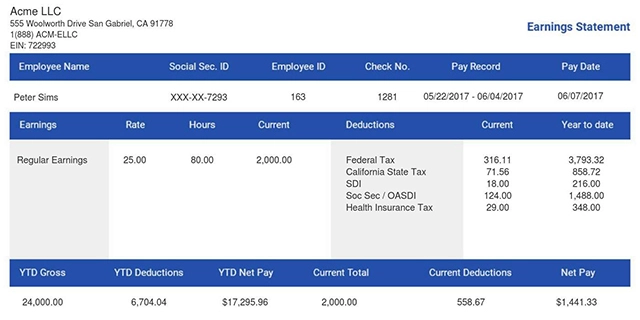
There's a gap between the band and your actual paperwork that catches people out. A band is written in annual terms. Your pay stub isn't. Say your band says $76,000 and your stub shows $2,923.08 of gross pay. Both numbers are right. Paid biweekly, that annual figure divides across 26 periods, which is why your pay period breakdown is worth understanding. That reconciliation matters the moment a landlord or lender asks you to prove income, because they'll work from the stub, not the band.
Need pay documentation for a rental application or loan? Our pay stub templates make it straightforward.
You Might Also Like
- What Is Net Salary?
- Pay Stubs for Loan Applications
- Proof of Income Documents: 6 Instances You'll Need a Pay Stub
- What Is Compensation in Human Resources?
- State Pay Stub Laws
Conclusion: Making Salary Bands Work for You
A salary band is just three numbers and the reasoning behind them. Know the midpoint and you know what the market pays for your level. Know your compa ratio and you know exactly where you stand against it.
If you're building bands, start with one job family, pull free market data, set the midpoint, and add a spread. You can refine it later. A rough band applied consistently beats a perfect band that never gets used.
And whatever your band says on paper, the pay stub is what proves the income when a lender or landlord asks. Create professional pay stubs in minutes with our pay stub generator, with the calculations handled for you.
- 1. Enter Your Information

- 2. Select Your Favorite Theme

- 3. Download Your Stub!


 By
By