

How Is PTO Accrued? Rates, Formulas, and Your Pay Stub
 By
By
You glanced at your pay stub, spotted a PTO balance, and the number didn't match what you had in your head. Maybe it's lower than you expected. Maybe it hasn't moved in two months.
So how is PTO accrued? Most employers don't hand you the year's time off on January 1. They make you earn it in slices. The size of each slice comes from a formula you can check yourself in about a minute, the same arithmetic behind any pay stub generator. Below, we'll cover that formula and walk through the math for hourly, salaried, and part-time schedules. We'll also show you where the balance lives on your stub, and how to tell when it's wrong.
Key Takeaways
- PTO accrual means you earn paid time off in increments as you work, instead of receiving it all upfront.
- Most employers accrue either per hour worked or per pay period, and both trace back to one annual allotment.
- A 15-day (120-hour) allotment equals about 0.0577 hours per hour worked, or 4.62 hours per biweekly paycheck.
- Your accrued, used, and available balances usually appear on your pay stub, often one pay period behind.
- Caps, waiting periods, and unpaid leave are the three most common reasons a balance stops growing.
- How Is PTO Accrued? What "Accrued PTO" Really Means
- How Does PTO Accrual Work?
- How Is PTO Accrued Per Hour and Per Pay Period?
- What Is a Good PTO Accrual Rate?
- What Changes How Fast You Accrue PTO
- How Is PTO Accrued While You're on Leave?
- Caps, Rollover, and What Happens to Unused PTO
- Where to Find Accrued PTO on Your Pay Stub
- How to Check Your PTO Accrual Is Correct
How Is PTO Accrued? What "Accrued PTO" Really Means
PTO is accrued when you earn paid time off in small increments as you work, rather than receiving the full year's allowance upfront. Your employer sets an annual allotment, then credits a fraction of it each hour worked or each pay period. Accrued time is what you have earned so far.
That's different from front-loaded PTO, where the whole year's balance lands at once. It's also different from your available balance. Accrued is everything you've earned to date; available is what's left after the time you've taken and the trip you've got booked for next month.
Employers lean on accrual because it limits what they owe. Take that time in February under a front-loaded plan and you may be using hours you hadn't worked for yet. Under accrual, you've earned what you've earned.
How Does PTO Accrual Work?

PTO accrual works by tying your time off to an accrual base. Your employer picks an annual allotment, such as 120 hours, then divides it across either hours worked or pay periods. You earn a slice each cycle, and that slice lands in your balance after the period is worked.
So how is PTO accrued once you strip away the jargon? Only two things decide it: how much time you get in a year, and what you have to do to earn each piece of it.
Accrual Per Hour Worked
You earn a set fraction of an hour for every hour on the clock. It's the standard for hourly roles because it scales automatically. Work a 50-hour week and you earn more than in a 30-hour week, with no separate calculation. Most state paid sick leave rules use this base too.
Accrual Per Pay Period
You earn a fixed amount each paycheck regardless of exact hours. Salaried employees usually fall here, since their hours aren't tracked the same way. How your pay period is structured decides how often that credit lands. It's predictable and easier to administer.
Front-loaded, or Lump Sum
Instead of accruing, you get the full allotment at the start of the year or on your work anniversary. Employers carry more risk this way, so some prorate it for anyone hired mid-year.
Tiered Accrual by Tenure
Your rate steps up at service milestones. A common structure gives new hires 10 days, bumps to 15 after a few years, then 20 after five or more. The base doesn't change, just the allotment feeding it.
How Is PTO Accrued Per Hour and Per Pay Period?
How is PTO accrued in practice? Here's one employee run through every method, so you can see why the same benefit produces such different-looking numbers. She gets 15 days of PTO, works 8-hour days on a 40-hour week, and her employer counts a full year as 2,080 hours.
First, convert days to hours, since accrual is almost always tracked in hours:
15 days × 8 hours = 120 hours per year.
Now run that 120-hour allotment through each base:
| Accrual base | Formula | Result |
|---|---|---|
| Per hour worked | 120 ÷ 2,080 | 0.0577 hours per hour worked |
| Per week | 0.0577 × 40 | 2.31 hours per week |
| Biweekly (26 pay periods) | 120 ÷ 26 | 4.62 hours per pay period |
| Semi-monthly (24 pay periods) | 120 ÷ 24 | 5.00 hours per pay period |
| Monthly (12 periods) | 120 ÷ 12 | 10.00 hours per month |
Same benefit every time. The number just looks different depending on how it's sliced.
Fewer Hours, Same Rate
Run that 0.0577 figure against a 20-hour week: 0.0577 × 20 = 1.15 hours per week, or about 2.31 hours per biweekly paycheck. You're earning at an identical speed per hour, just clocking half as many. Where the line falls between part-time and full-time hours is set by your employer, not by federal law.
This works backwards too. Divide the accrued hours on your stub by your accrual rate and you'll get the hours you've been credited for. If that doesn't match what you've actually worked, something's off.
What Is a Good PTO Accrual Rate?

A common full-time rate is 10 to 15 days per year, which works out to 3.08 or 4.62 hours per biweekly paycheck. Bureau of Labor Statistics data from March 2025 shows 31% of private industry workers received 10 to 14 vacation days after one year of service.
Tenure moves that number. After 10 years of service, 31% of private industry workers landed in the 15 to 19 day range, per the same BLS paid vacation data.
Employer size matters more than most people expect. Paid vacation reached 91% of workers at private employers with 500 or more staff, but only 71% at those with fewer than 50. Setting a rate for a small team? That gap is your competitive opening, not a reason to match the big players hour for hour.
What Changes How Fast You Accrue PTO
How is PTO accrued so differently for two people doing the same job? Accrual rates shift for a handful of concrete reasons:
- Waiting period. Many employers hold off on accrual, or on your ability to use it, for the first 30 to 90 days. Some make it retroactive to your hire date once you clear it, some don't.
- Employment status. Part-time, seasonal, and temporary workers often accrue at a reduced rate or not at all, subject to state law. Employers often express this as an FTE, or full-time equivalent.
- Tenure tier. Hit a service anniversary and your allotment goes up, raising every per-period number underneath it.
- Accrual cap. Once your balance hits the ceiling, accrual stops until you use some time. This one surprises people, because nothing announces it.
- Bonus PTO. Time awarded for a goal or milestone sits outside the formula entirely. It's handled separately, much like PTO hours are treated for overtime.
How Is PTO Accrued While You're on Leave?
While you are on paid leave, including time off you booked with PTO, you normally keep accruing because you remain in paid status. During unpaid leave, accrual usually pauses. FMLA leave is job-protected but unpaid, so federal law does not require your PTO to keep building during it.
The Department of Labor's FMLA fact sheet covers the basics. Eligible employees get up to 12 workweeks of job-protected, unpaid leave in a 12-month period. Group health coverage continues throughout, and your employer can require you to use accrued paid leave at the same time. What federal law doesn't say is whether PTO keeps accruing during the unpaid stretch. That's company policy, and it has to match how your employer treats comparable unpaid leave.
An extended leave of absence is where this matters most. Sick and disability leave follow the same logic. Paid means accrual typically continues. Unpaid means it typically stops, unless your state or employer says otherwise.
Don't have pay records showing your accrual history? Our pay stub templates make it easy to document your earnings properly.
Caps, Rollover, and What Happens to Unused PTO
Earning the time is one thing. Keeping it is another.
Caps. Employers commonly cap balances at 1.5 to 2 times the annual allotment. A balance cap freezes accrual at a ceiling; an annual cap limits what you earn in a single benefit year.
Rollover. Some plans let unused time carry into the next year, sometimes with a limit. Others run use-it-or-lose-it. Several states restrict forfeiture, so your handbook isn't automatically the last word.
Payout at separation. In some states accrued PTO counts as earned wages and must be paid out when you leave. In others it's up to the employer. Either way, a PTO payout is taxable income, so the gross figure won't be what hits your account. This is the most expensive detail to get wrong.
Negative balances. Some employers let you borrow against future accrual for emergencies, expecting you'll earn it back.
More states now set minimum accrual rules or restrict what happens to unused time. These rules shift year to year, so check your state labor department instead of assuming your handbook is current.
Where to Find Accrued PTO on Your Pay Stub
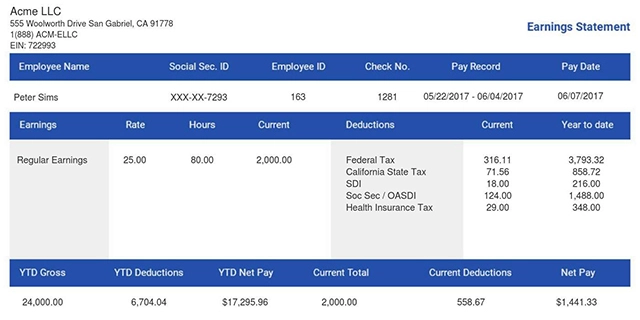
Most pay stubs carry a leave or accrual block, usually near the bottom, separate from earnings and deductions. If you're not sure what a pay stub looks like section by section, start there. It's easy to miss because it's often the smallest section on the page.
You'll typically see three columns:
- Accrued. Hours you've earned to date, or sometimes just the hours earned this period.
- Used. Hours you've already taken.
- Available. What's actually bookable right now: accrued minus used, minus anything already scheduled.
Two things trip people up. First, the balance reflects the pay period being paid, not today, so it usually runs a period behind. Second, nearly every stub reports hours rather than days. Divide by your standard day length: 60 hours at an 8-hour day is 7.5 days, not 60.
No PTO line at all? That's not unusual, since not every payroll template includes one, and pay stub requirements vary by state. Ask HR for your balance in writing so you've got a record.
How to Check Your PTO Accrual Is Correct
How is PTO accrued on paper versus what your stub actually shows? Confirm three inputs first: your annual allotment, your hours base (2,080 for full-time), and the date accrual started. Get any of those wrong and every figure downstream is wrong too.
Then run the reverse-check. Multiply hours worked since the accrual start date by your accrual rate, then compare it to the accrued figure on your stub. Worked 500 hours at 0.0577? You should be near 28.85 hours.
When the numbers don't reconcile, it's usually one of four things:
- The waiting period was applied from the wrong start date.
- An accrual cap quietly stopped your accrual weeks ago.
- A 2,080-hour base was used for someone who doesn't work 2,080 hours.
- Unpaid leave paused accrual without anyone telling you.
Keep your own running check in Google Sheets or Excel. Use three columns, one row per pay date: hours worked, the accrued balance from your stub, and the difference. Two or three periods in, a bad rate becomes obvious because the increment stops matching. Save each stub PDF too, because if a payout is ever disputed, your stubs are the record.
You Might Also Like
- What Is Unlimited PTO?
- Negative PTO: What Happens When You Go Below Zero
- Unpaid PTO: How It Works
- Free PTO Policy Template
- How Many Sick Days a Year Is Normal?
Conclusion
How is PTO accrued? It's arithmetic, not mystery. Your annual allotment divided by your accrual base gives you a rate. Apply that rate to your hours and you get a balance. That balance then shows up on your pay stub a period behind. Once you know those three inputs, you can check the number yourself instead of taking it on faith.
Pull up your most recent stub and run the reverse-check. If you need clean pay documentation for a rental application, a loan, or your own records, our paystub generator creates professional pay stubs in minutes.
- 1. Enter Your Information

- 2. Select Your Favorite Theme

- 3. Download Your Stub!

 By
By